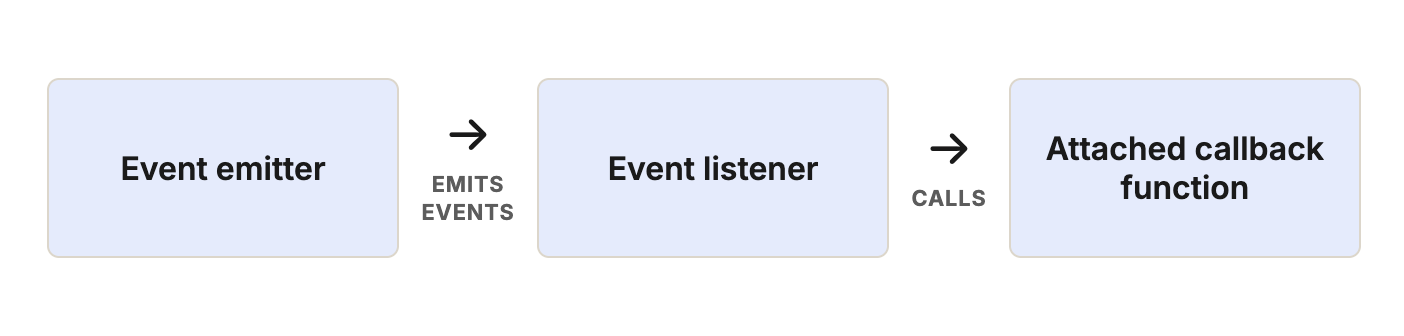
Core idea: Node's built-in modules (http, fs, timers) run on an event-driven model with two roles:
📤 Emitter — an object that fires a named event when something happens (a request comes in, a timer ends, a file finishes reading)
👂 Listener — a callback you attach ahead of time, which runs when that event fires
🌐 Example: HTTP server as an emitter
const server = http.createServer();

server.on('request', (req, res) => {
  console.log('Request received');
  res.end('Request received');
});
Walking through it:
👂
server.on('request', callback)registers a listener for'request'.📤 Every incoming request makes the server emit a
'request'event.✅ Because a listener is already attached, the callback runs and responds to the client.
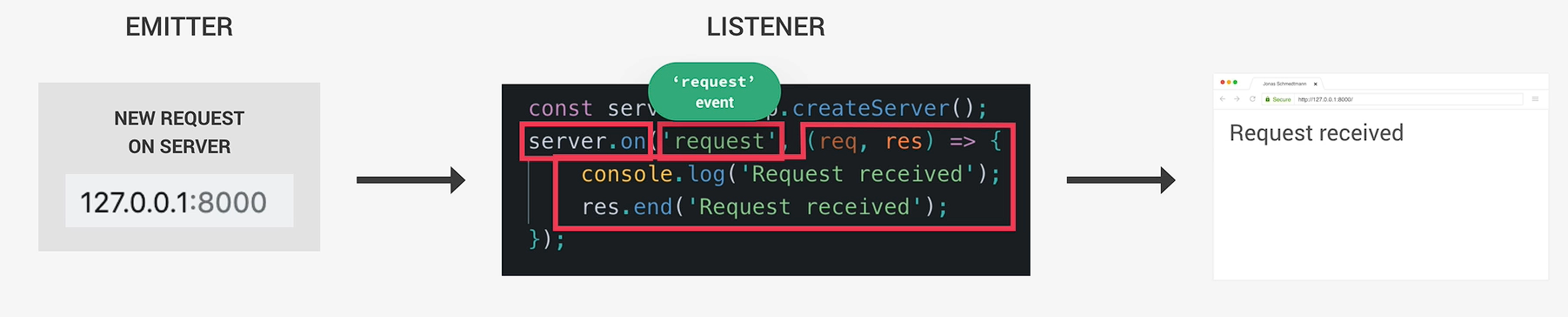
Why this works: 💡 server is an instance of Node's EventEmitter class — it inherits emitting and listening behavior from there.
👀 This is the Observer Pattern
EventEmitter is Node's implementation of the Observer Pattern:
👂 The observer (listener) waits.
📤 The subject (emitter) eventually fires the event it's waiting for.
⚡ Code reacts to events instead of being called directly — the reverse of a normal function call.
🎯 Why it's useful
🔗 Decoupling — modules don't call each other's functions directly.
fsdoesn't need to know anything abouthttp; each module just emits its own events, and any other code can listen and react.👥 One event, many reactions — attach several listeners to the same event with no extra wiring.
✅ Takeaway
📤 Emitter fires an event → 👂 listener reacts with a callback. 🚀 This pattern is foundational across Node's core API, and the next lecture puts it into practice directly with EventEmitter.