🔐 JSON Web Tokens (JWT)
In this lesson, we are going to break down JWT, which stands for JSON Web Token.
JWT is one of the most widely used authorization mechanisms in modern APIs — especially in backend systems and microservice architectures.
📌 What is a JSON Web Token?
A JSON Web Token (JWT) is a self-contained way to securely transmit information between two or more parties using a JSON object.
It is:
Digitally signed
Compact
URL-safe
Stateless
Because it is digitally signed, the server can verify whether the token has been altered after being issued.
🔎 Important Clarification: Authentication vs Authorization
JWT is not authentication.
JWT is an authorization mechanism.
🔑 Authentication → Verifies who you are (login with username/password).
🛂 Authorization → Verifies what you are allowed to access.
Typical flow:
User logs in (authentication).
Server validates credentials.
Server returns a JWT.
Client sends JWT with every request.
Server validates the token before allowing access.
This avoids logging in on every request.
🧱 JSON Web Token Structure
Every JWT has three parts, separated by dots:
HEADER.PAYLOAD.SIGNATUREVisually:
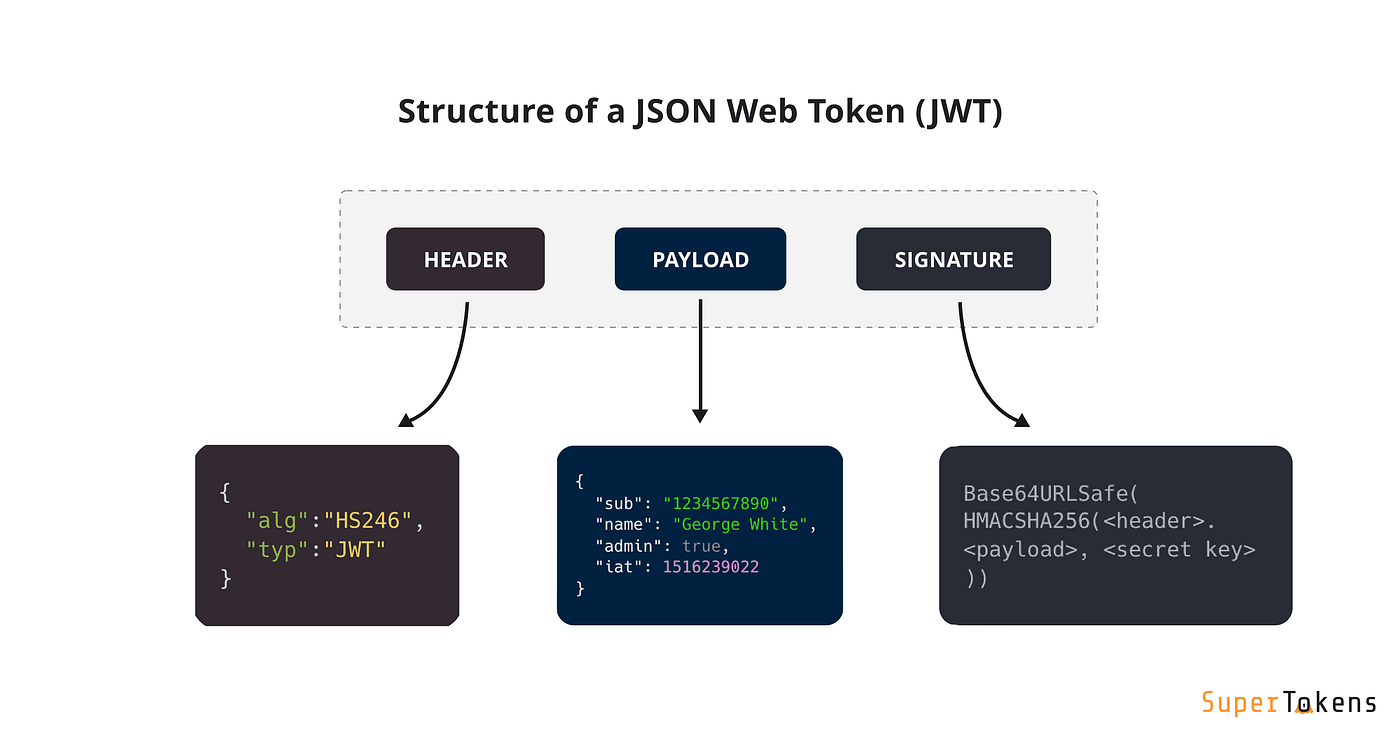
Each part is Base64 encoded and joined using dots.
🧩 The JWT Header
The header contains metadata about the token.
It usually includes:
alg→ Signing algorithm (e.g., RS256)typ→ Token type (e.g., JWT)
Example
{
  "alg": "RS256",
  "typ": "JWT"
}
This JSON object is Base64-encoded to form the first part of the JWT.
📦 The JWT Payload
The payload contains the actual data. The data inside a payload is called claims.
Example
{
  "sub": "123",
  "email": "user@example.com",
  "role": "admin",
  "exp": 1710000000
}
🏷️ What Are Claims?
Claims are key-value pairs inside the payload.
There are 3 types of claims:
1️⃣ Registered Claims
Predefined standard claims recommended by JWT specification.
Common ones:
Claim | Meaning |
|---|---|
| Subject (usually user ID) |
| Expiration time |
| Issued at |
| Not before |
| Issuer |
| Audience |
Example:
{
  "sub":"42",
  "exp":1710000000,
  "iat":1709990000
}
✅ Used for security & token validation
✅ Standard across systems
2️⃣ Public Claims
Custom claims defined by you but intended to be public.
Example:
{
  "role":"admin",
  "username":"bhaskar"
}
⚠️ To avoid collision, use unique names (sometimes namespaced like app_role).
Used for:
Roles
Permissions
Application-level data
3️⃣ Private Claims
Custom claims shared only between specific parties.
Example:
{
  "department_id":"IT-09",
  "internal_flag":true
}
These are:
Not standardized
Agreed upon between backend & frontend
Used for internal system logic.
🚨 Important Security Notes
✔ JWT payload is readable (just Base64 encoded)
✔ Do NOT store passwords or sensitive secrets
✔ Always set exp claim
✔ Keep payload minimal
🔏 The JWT Signature
The signature ensures the token hasn’t been altered.
It is created by: For HMAC (HS256) algorithm:
HMACSHA256(
  base64UrlEncode(header) + "." +
  base64UrlEncode(payload),
  secret
)
The secret key:
Lives on the server
Is never shared with the client
If the client discovers the secret key, they can forge valid tokens — which is a massive security risk.
🔎 What Happens if the Token is Modified?
You can try test encoding and decoding tokens at:
<https://jwt.io>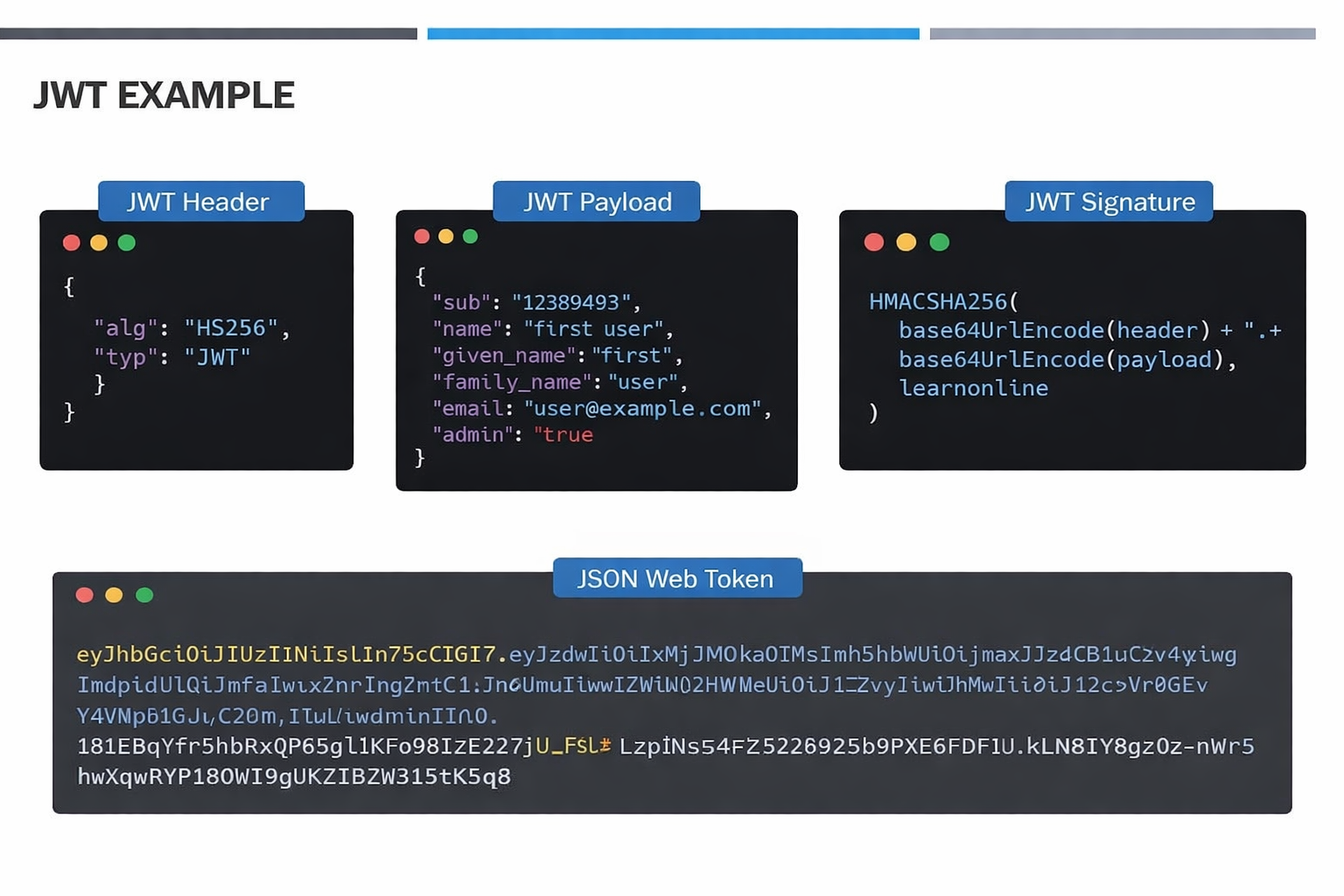
If:
Header changes
Payload changes
Secret changes
The signature becomes invalid.
The server will reject the request immediately.
That’s why JWT is trusted for authorization.
On that site, if you modify even a single character of the secret, you’ll instantly see:
Invalid SignatureThis proves how sensitive and secure the mechanism is.
📌 How JWT is Sent in Requests
Most APIs send JWTs in the Authorization header using the Bearer schema:
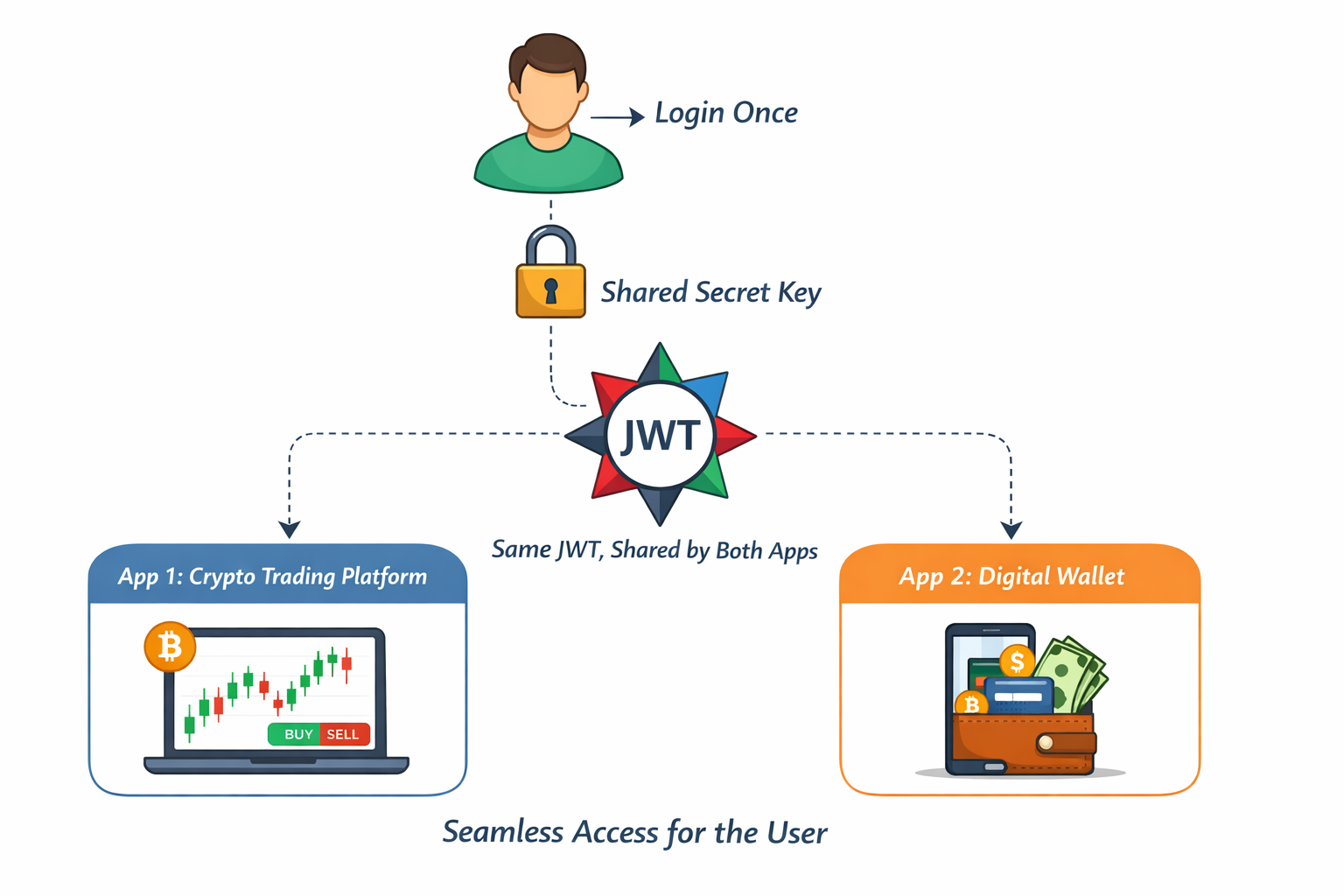
Authorization: Bearer <your_token_here>🚀 Practical Use Case: Multiple Applications (SSO Concept)
Imagine a company owns:
App 1 → Cryptocurrency trading platform
App 2 → Digital wallet
Instead of logging in twice:
User logs in once.
Both apps share the same secret.
Both servers can decode the same JWT.
Seamless experience for the user.
Visually:
This pattern is common in:
Microservices architectures
Distributed systems
Stateless APIs
Enterprise applications
Each service can decode the JWT, extract user information, and authorize requests without implementing login again.