🤔 What is Handoff? (Basic Idea)
When a mobile user is moving, the signal strength from the current cell reduces, and the signal from a neighboring cell increases.
📌 To maintain continuous communication, the connection must be transferred.
👉 This process is called Handoff (or Handover).
🧠 Simple Definition
📌 Handoff is the process of transferring an active call or data session from one base station (cell) to another without interrupting the communication.
🧠 Real-Life Analogy
🚗 Driving Through Cities
You move from one city to another
Mobile tower coverage changes
Call continues without disconnecting
👉 Switching towers = Handoff
🎯 Why Handoff is Necessary
Handoff is needed to:
🚶 Support user mobility
📞 Prevent call drops
📶 Maintain signal quality
🌍 Enable seamless coverage
📌 Without handoff → calls would drop every few meters ❌
🧭 Where Does Handoff Occur?
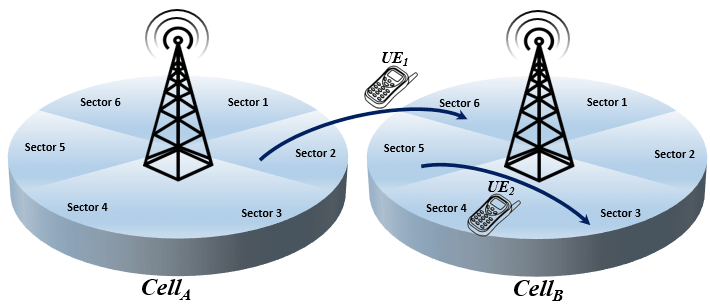
Occurs between cells
Managed by:
RAN (Base Stations)
Core Network
🔁 When is a Handoff Triggered?
Handoff is initiated when:
Signal strength falls below threshold 📉
Neighbor cell signal becomes stronger 📈
User moves across cell boundary
Network load balancing required
🧩 Basic Steps in Handoff Process
1️⃣ Signal strength monitored
2️⃣ Handoff decision made
3️⃣ New channel allocated
4️⃣ Connection switched
5️⃣ Old channel released
📌 Happens in milliseconds ⚡
🧠 Types of Handoff Techniques
Handoff techniques are classified based on connection behavior, network type, and decision control.
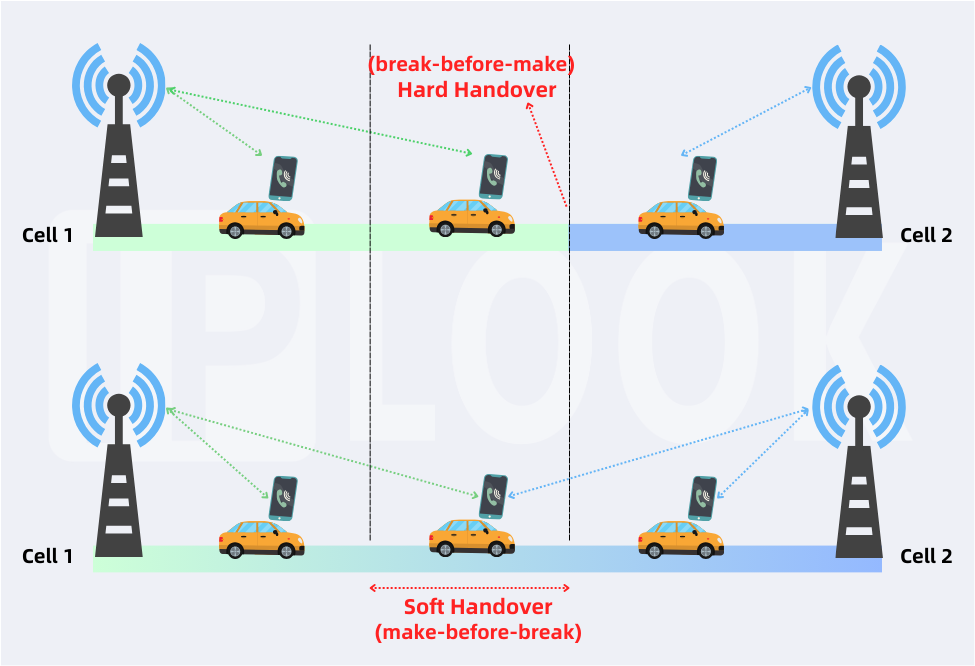
🔥 Hard Handoff (Break-Before-Make)
🧠 What is Hard Handoff?
Old connection is terminated first
New connection is established later
📌 Momentary disconnection occurs.
🧠 Example
Used in GSM (2G, 3G)
✅ Advantages
Simple implementation
Low resource usage
❌ Disadvantages
Call drop risk
Brief interruption
📌 Hard = Harsh break
🌊 Soft Handoff (Make-Before-Break)
🧠 What is Soft Handoff?
Mobile connects to multiple base stations simultaneously
Old connection released after new one is stable
📌 No call drop ✔️
🧠 Example
Used in CDMA, 3G
✅ Advantages
Seamless transition
Higher reliability
❌ Disadvantages
Higher resource usage
Complex implementation
📌 Soft = Smooth transition
⚖️ Hard vs Soft Handoff
Feature | Hard Handoff | Soft Handoff |
|---|---|---|
Connection | Break → Make | Make → Break |
Call drop | Possible | Rare |
Complexity | Low | High |
Used in | GSM | CDMA |
🧠 What is Horizontal Handoff?
Handoff between same network technology
Example:
4G → 4G
Wi-Fi → Wi-Fi
📌 Most common type.
🧠 What is Vertical Handoff?
Handoff between different technologies
Example:
Wi-Fi → 4G
4G → 5G
📌 Used in heterogeneous networks.
🔹 Decision made by:
Network (base stations / core)
📌 Used in:
Early cellular systems (2G)
🔹 Decision made by:
Mobile measures signal
Network makes final decision
📌 Used in:
GSM networks
🔹 Decision made by:
Mobile device itself
📌 Used in:
Some Wi-Fi systems
📊 Handoff Techniques Summary Table
Type | Description |
|---|---|
Hard | Break before make |
Soft | Make before break |
Horizontal | Same technology |
Vertical | Different technology |
Network-controlled | Network decides |
Mobile-assisted | Mobile helps |
Mobile-controlled | Mobile decides |
⚠️ Challenges in Handoff
Signal fluctuation
High speed movement 🚄
Interference
Delay in decision
📌 Poor handoff → call drop ❌
🧠 Handoff in Modern Networks (4G/5G)
Faster decision algorithms
Lower latency
Seamless data sessions
AI-based optimization
📌 Designed for high-speed mobility.
🧠 Memory Tricks
Hard = Break first 💥
Soft = Smooth 🌊
Horizontal = Same
Vertical = Different
⭐ One-Line Summary
🔹 Handoff techniques ensure uninterrupted communication by transferring mobile connections between cells or networks as users move.