🤔 What is Cellular Network Architecture? (Basic Idea)
Cellular Network Architecture describes:
How a mobile network is structured
What components it has
How these components work together to provide:
Voice calls 📞
SMS 💬
Mobile Internet 🌐
📌 In simple words:
It is the internal design of a mobile network that enables communication between mobile users.
🧠 Why Do We Need a Proper Architecture?
A mobile network must:
Support millions of users
Allow mobility
Handle handover
Provide security
Scale easily
👉 A well-defined architecture makes this possible.
🧩 High-Level View of Cellular Network Architecture
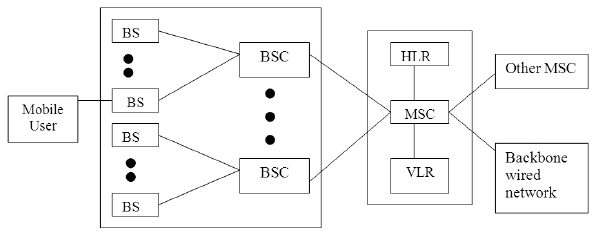
At a high level, a cellular network has three main parts:
1️⃣ Mobile Station (MS / UE)
2️⃣ Radio Access Network (RAN)
3️⃣ Core Network (CN)
🧠 What is Mobile Station?
The Mobile Station is the user’s device.
📌 Examples:
Smartphone 📱
Tablet
IoT device
🧩 Components of Mobile Station
Component | Function |
|---|---|
Mobile Device | Hardware (phone) |
SIM / USIM | Subscriber identity & authentication |
🔐 Role of SIM Card
Stores subscriber identity (IMSI)
Authentication keys
Network information
📌 SIM enables secure access to the network.
🧠 What is RAN?
RAN connects:
Mobile devices 📱
to
Core Network 🌐
👉 It handles wireless communication.
🧱 Main Components of RAN
Depends on the generation:
Generation | Base Station Name |
|---|---|
2G | BTS |
3G | Node B |
4G | eNodeB |
5G | gNodeB |
🧠 Functions of RAN
Radio signal transmission 📶
Channel allocation
Power control
Handover management
📌 RAN is responsible for last-mile wireless connectivity.
🧠 What is Core Network?
The Core Network is the brain of the cellular system.
It handles:
Call routing 📞
Internet access 🌐
Authentication 🔐
Mobility management 🚶
🧩 Core Network Components (Traditional View)
📞 MSC (Mobile Switching Center) – (2G/3G)
📌 Handles:
Voice calls
Call switching
Call control
📊 HLR (Home Location Register)
Stores permanent subscriber data
User profile
Service permissions
📍 VLR (Visitor Location Register)
Temporary subscriber info
Used when user is roaming
🔐 AuC (Authentication Center)
Stores security keys
Authenticates users
🧠 Evolved Core Network (4G/5G)
In modern networks:
🌐 MME (Mobility Management Entity)
User authentication
Mobility management
Session control
📦 SGW (Serving Gateway)
Routes data packets
Connects RAN to core
🌍 PGW (Packet Data Network Gateway)
Connects mobile network to Internet
Assigns IP addresses
🔐 HSS (Home Subscriber Server)
Advanced version of HLR
Stores user subscription data
🔄 How Communication Happens (Step-by-Step)
🪜 Example: Making a Call
1️⃣ Mobile connects to nearest base station
2️⃣ RAN forwards request to core
3️⃣ Core authenticates user
4️⃣ Call routed to destination
5️⃣ Voice/data flows back to mobile
📌 Happens in milliseconds ⚡
🔁 Handover Support in Architecture
📌 When a user moves:
Signal weakens in current cell
Stronger signal detected from another cell
Network switches connection automatically
👉 This is handled mainly by RAN + Core Network.
🧠 Architecture Evolution Across Generations
Generation | Architecture Focus |
|---|---|
2G | Voice-centric |
3G | Voice + Data |
4G | All-IP network |
5G | Service-based architecture |
🛡️ Security in Cellular Architecture
Security is built-in using:
Authentication (SIM-based)
Encryption
Secure core functions
📌 Prevents unauthorized access.
🧠 Advantages
Scalable 🌍
Supports mobility 🚶
Efficient frequency reuse
Reliable communication
❌ Challenges
High infrastructure cost 💰
Complex management
Interference issues
🧠 Memory Tricks
MS = My Smartphone 📱
RAN = Radio Access 📡
Core = Brain 🧠
⭐ One-Line Summary
🔹 Cellular network architecture consists of mobile devices, radio access networks, and a core network that together provide secure, scalable, and mobile communication services.