🤔 Why Do We Need TCP and UDP?
Different applications have different requirements:
Some need accuracy & reliability ✔️
Some need speed & low delay ✔️
📌 A single protocol cannot satisfy both.
👉 So, the Transport Layer provides two protocols:
TCP → Reliable
UDP → Fast
🧠 Basic Definitions
📌 TCP is a connection-oriented, reliable transport protocol that ensures error-free and ordered data delivery.
📌 UDP is a connectionless, fast transport protocol that sends data without guaranteeing delivery or order.
🧭 Connection-Oriented vs Connectionless
🔗 TCP – Connection-Oriented
Connection is established first
Data transfer happens
Connection is terminated
📌 Like a phone call 📞
📤 UDP – Connectionless
No connection setup
Data sent directly
📌 Like sending a letter 📮
🤝 TCP Connection Establishment (3-Way Handshake)
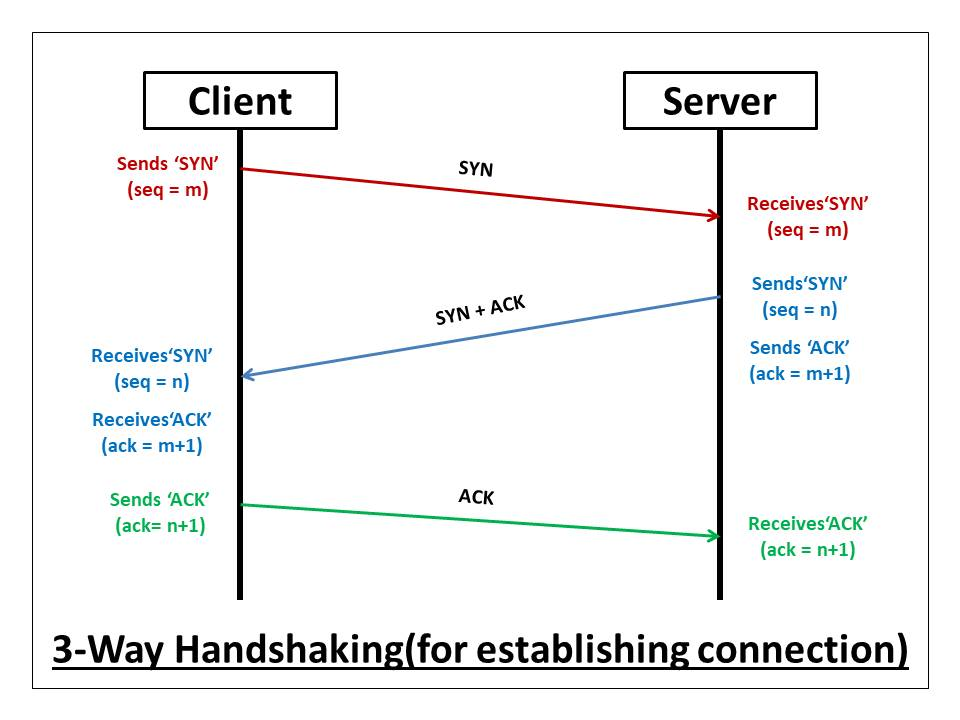
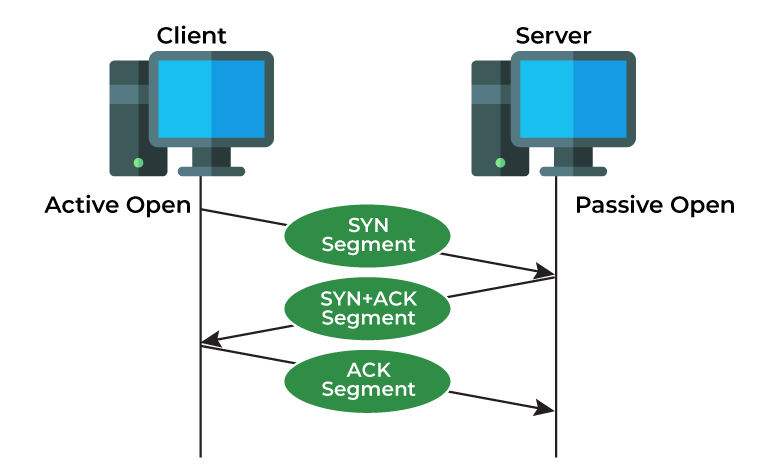
🧠 Steps:
1️⃣ SYN → Request connection
2️⃣ SYN-ACK → Acknowledge
3️⃣ ACK → Connection established
📌 Ensures both sides are ready.
🚫 UDP – No Handshake
No connection setup
No acknowledgment
No guarantee of delivery
📌 Faster, but risky.
🔹 TCP
Segments numbered
Delivered in correct order
Reassembled properly
🔹 UDP
No sequencing
May arrive out of order
🔹 TCP
Error detection ✔️
Retransmission ✔️
Acknowledgments ✔️
📌 Reliable delivery guaranteed.
🔹 UDP
Error detection only ❌
No retransmission ❌
📌 Reliability not guaranteed.
🔹 TCP
Uses sliding window
Prevents buffer overflow
🔹 UDP
No flow control
Sender sends freely
TCP → Slower (overhead)
UDP → Faster (lightweight)
📌 UDP preferred for real-time communication.
📦 Header Size
Protocol | Header Size |
|---|---|
TCP | 20–60 bytes |
UDP | 8 bytes |
📌 Smaller header = faster transmission.
🧠 TCP vs UDP – Detailed Comparison Table
Feature | TCP | UDP |
|---|---|---|
Full Form | Transmission Control Protocol | User Datagram Protocol |
Connection | Connection-oriented | Connectionless |
Reliability | Reliable | Unreliable |
Speed | Slower | Faster |
Error Control | Yes | No |
Flow Control | Yes | No |
Congestion Control | Yes | No |
Ordering | Maintained | Not maintained |
Header Size | Large | Small |
Acknowledgment | Required | Not required |
🌐 Common Applications Using TCP
📌 TCP is used where accuracy matters:
🌐 HTTP / HTTPS
📧 Email (SMTP, POP3)
📂 File Transfer (FTP)
🔐 Secure communication
🎥 Common Applications Using UDP
📌 UDP is used where speed matters:
🎥 Live video streaming
🎮 Online gaming
📞 VoIP
📡 DNS
🧠 Real-Life Example Comparison
Scenario | TCP | UDP |
|---|---|---|
File download | ✔️ Yes | ❌ No |
Live match streaming | ❌ No | ✔️ Yes |
Online form submission | ✔️ Yes | ❌ No |
Video call | ❌ No | ✔️ Yes |
⚠️ When to Use What?
✅ Use TCP when:
Data must be correct
No data loss allowed
Order matters
✅ Use UDP when:
Speed is critical
Minor data loss acceptable
Real-time communication
🧠 TCP & UDP in OSI Model
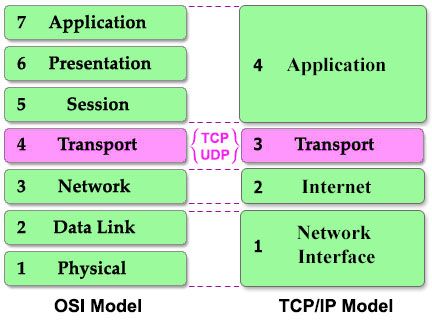
Both operate at:
Transport Layer (Layer 4)
🧠 Memory Tricks (Very Useful)
TCP = Trust, Control, Patience
UDP = Urgent, Direct, Performance
⭐ One-Line Summary
🔹 TCP provides reliable, ordered communication, while UDP provides fast, connectionless communication without guarantees.