🤔 Why Do We Need Multiplexing & Demultiplexing?
A single device can run many applications at the same time:
🌐 Web browser
📧 Email client
🎮 Online game
📂 File download
📌 All these applications want to:
Send data ❌
Receive data ❌
Use the same network interface ❌
👉 How is this possible without confusion?
💡 Answer: Multiplexing & Demultiplexing
🧠 Simple Definitions
🔀 Multiplexing
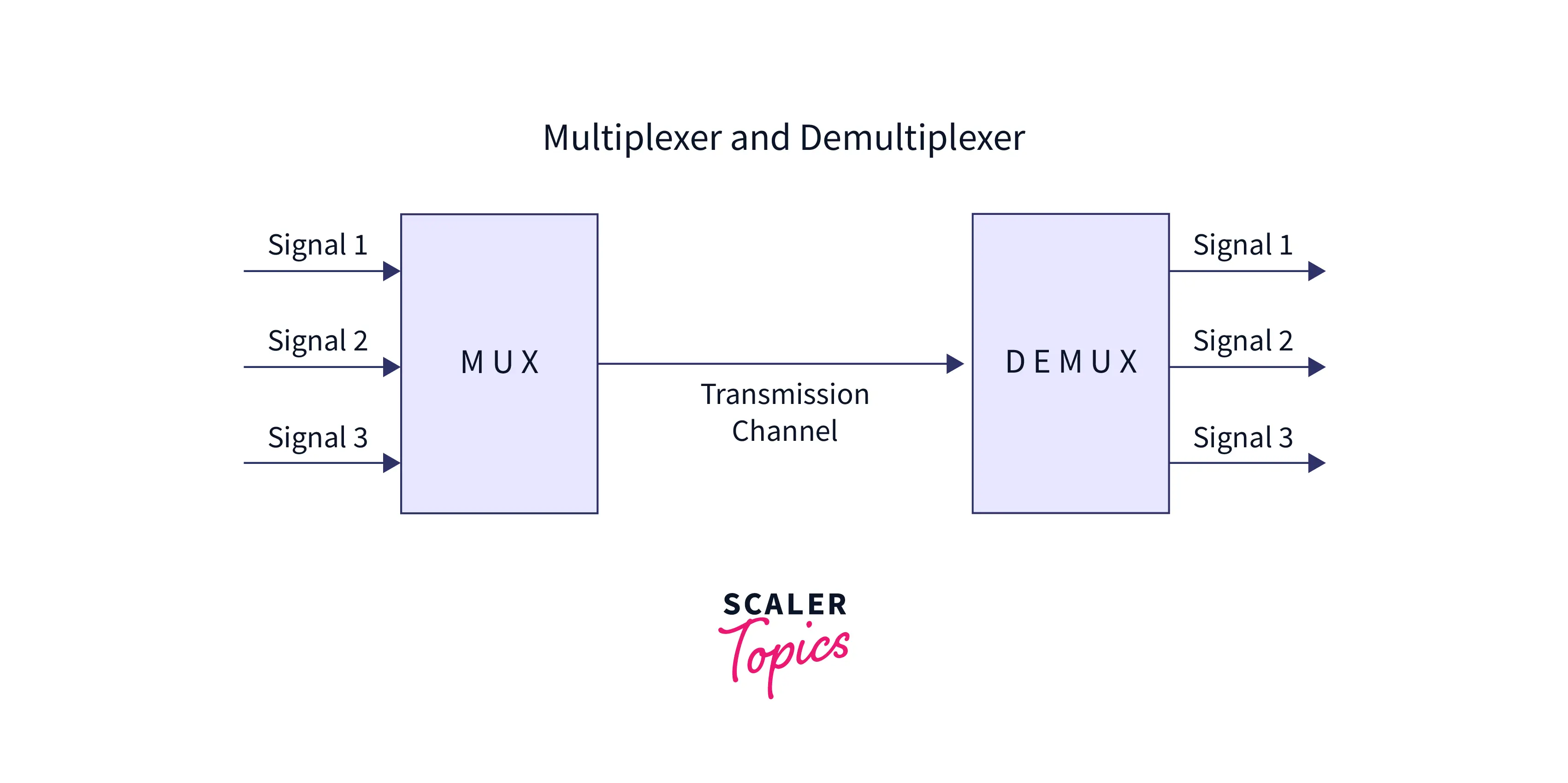
📌 Multiplexing is the process of combining data from multiple applications and sending it over the network through a single channel.
🔁 Demultiplexing
📌 Demultiplexing is the process of receiving data from the network and delivering it to the correct application.
🧠 One-Line Understanding
📤 Multiplexing → Many → One
📥 Demultiplexing → One → Many
🧠 Real-Life Analogy (Very Easy to Remember)
📮 Post Office Example
Many letters from different people → Multiplexing
Post office sorts letters by address → Demultiplexing
👉 Transport Layer works exactly the same way.
🧭 Where Do Multiplexing & Demultiplexing Occur?
Performed at the Transport Layer
Uses:
Port numbers
IP addresses
Protocol (TCP/UDP)
📌 Network Layer does NOT handle applications.
📤 Multiplexing (Sender Side)
🧠 What Happens at Sender?
1️⃣ Multiple applications generate data
2️⃣ Each application is assigned a port number
3️⃣ Transport Layer:
Adds source & destination port
Creates segments
4️⃣ Segments are passed to Network Layer
📌 All data flows through one network connection.
🧠 Example
Application | Source Port |
|---|---|
Browser | 52345 |
52346 | |
File Transfer | 52347 |
👉 Transport Layer multiplexes them.
📥 Demultiplexing (Receiver Side)
🧠 What Happens at Receiver?
1️⃣ Segments arrive from Network Layer
2️⃣ Transport Layer reads:
Destination port number
3️⃣ Data is delivered to:
Correct application
📌 Each application receives only its own data.
🧠 Example
Destination Port | Application |
|---|---|
80 | Web Server |
25 | Mail Server |
21 | FTP Server |
👉 Transport Layer demultiplexes data.
🔌 Role of Ports in Multiplexing & Demultiplexing
📌 Ports are the key identifiers.
Without ports:
Data reaches device ✔️
But not the correct application ❌
👉 Ports solve this problem.
🧠 Multiplexing & Demultiplexing
🔹 TCP Characteristics
Connection-oriented
Uses socket pairs
📌 TCP identifies a connection using:
(Source IP,Source Port, Destination IP, Destination Port)👉 This ensures:
Reliable delivery
Correct application mapping
🔹 UDP Characteristics
Connectionless
Simpler demultiplexing
📌 UDP uses:
Destination port
Destination IP
👉 Faster but less strict.
⚖️ TCP vs UDP (Multiplexing Perspective)
Feature | TCP | UDP |
|---|---|---|
Connection | Required | Not required |
Identification | 4-tuple | Port-based |
Reliability | High | Low |
Complexity | High | Low |
🧠 Why Transport Layer Handles This (Not Network Layer)
Layer | Responsibility |
|---|---|
Network Layer | Deliver packet to correct device |
Transport Layer | Deliver data to correct application |
📌 Multiplexing & demultiplexing are application-level tasks.
🔄 End-to-End View (Complete Picture)
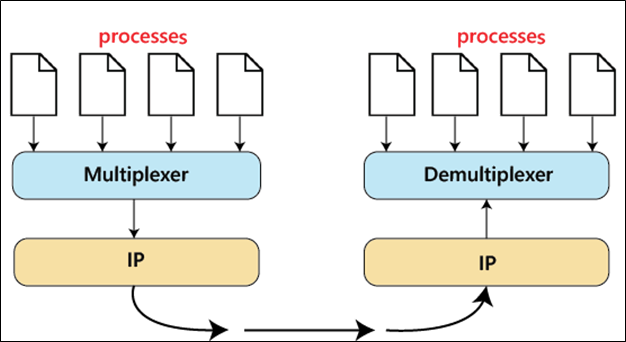
1️⃣ Application generates data
2️⃣ Transport Layer multiplexes
3️⃣ Network Layer routes
4️⃣ Transport Layer demultiplexes
5️⃣ Application receives data
🧠 Common Mistake to Avoid
❌ Multiplexing is done by Network Layer
✔️ Multiplexing is done by Transport Layer
⭐ Advantages of Multiplexing & Demultiplexing
Efficient use of network
Supports multiple applications
Prevents data confusion
Enables multitasking
⭐ Memory Trick
MULTIplexing → MULTI apps → One channel
DEmultiplexing → DEliver to correct app
⭐ One-Line Summary
🔹 Multiplexing combines data from multiple applications, and demultiplexing delivers data to the correct application using port numbers.