🤔 What is BGP? (Basic Idea)
Inside a small network (like a company), protocols like RIP and OSPF work well.
But the Internet is:
Huge 🌍
Made of thousands of independent networks
Controlled by different organizations
📌 How do these large networks communicate with each other?
👉 Answer: BGP
🧠 Simple Definition
📌 BGP (Border Gateway Protocol) is an inter-domain routing protocol used to exchange routing information between different autonomous systems on the Internet.
🧠 One-Line Understanding
BGP decides how data travels between large networks on the Internet.
🧠 Real-Life Analogy
✈️ International Flight Routing
Inside a city → local roads (OSPF, RIP)
Between countries → international air routes (BGP)
👉 BGP = Internet’s global traffic controller
🧭 Where Does BGP Work?
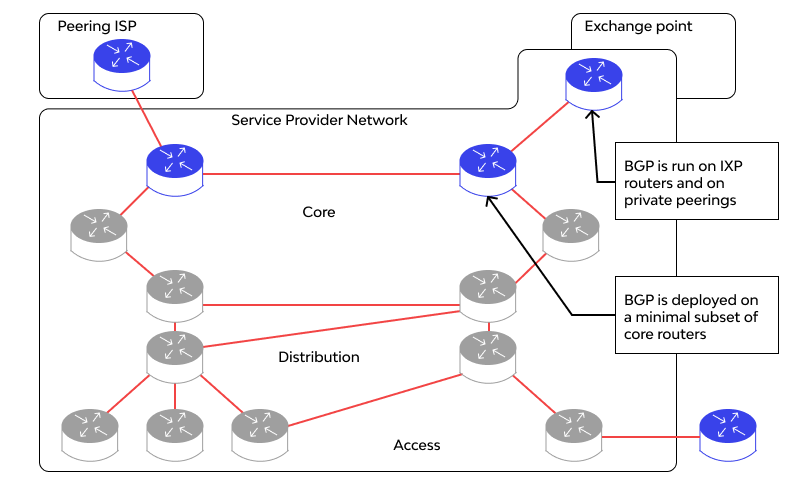
BGP works at the Network Layer
Uses TCP (reliable delivery)
Uses Port 179
📌 This makes BGP reliable and stable.
🧩 What is an Autonomous System (AS)?
📌 An Autonomous System (AS) is a collection of IP networks controlled by a single organization that follows a common routing policy.
🧠 Examples of AS
ISP networks
Google network
University networks
📌 Each AS is identified by a unique ASN (Autonomous System Number).
AS15169 → Google🔁 Why BGP is Needed (Compared to OSPF/RIP)
Protocol | Scope |
|---|---|
RIP | Small internal networks |
OSPF | Large internal networks |
BGP | Between different networks (Internet) |
👉 BGP is used for inter-domain routing.
🧠 Type of Routing Protocol
📌 BGP is a Path Vector Routing Protocol
Protocol | Type |
|---|---|
RIP | Distance Vector |
OSPF | Link State |
BGP | Path Vector |
🧠 What is Path Vector Routing?
Routes include:
Destination network
Complete path of AS numbers
📌 This helps prevent routing loops.
🧮 Routing Metric Used by BGP
❌ BGP does NOT use:
Hop count
Bandwidth
📌 BGP uses POLICY-BASED routing.
🔑 Important BGP Attributes
Attribute | Purpose |
|---|---|
AS-PATH | List of ASes a route passes through |
NEXT-HOP | Next router to reach destination |
LOCAL-PREF | Preferred path inside AS |
MED | Entry point preference |
ORIGIN | Route source |
👉 Shortest AS-PATH is usually preferred.
🧭 Types of BGP
🔵 1. eBGP (External BGP)
📌 Used between different ASes
Example:
ISP ↔ ISP
Company ↔ ISP
🟢 2. iBGP (Internal BGP)
📌 Used inside the same AS
Purpose:
Share external routes within AS
⚖️ iBGP vs eBGP
Feature | iBGP | eBGP |
|---|---|---|
AS | Same AS | Different AS |
Usage | Internal sharing | External routing |
Hop count | Not changed | Incremented |
🔄 How BGP Works (Step-by-Step)
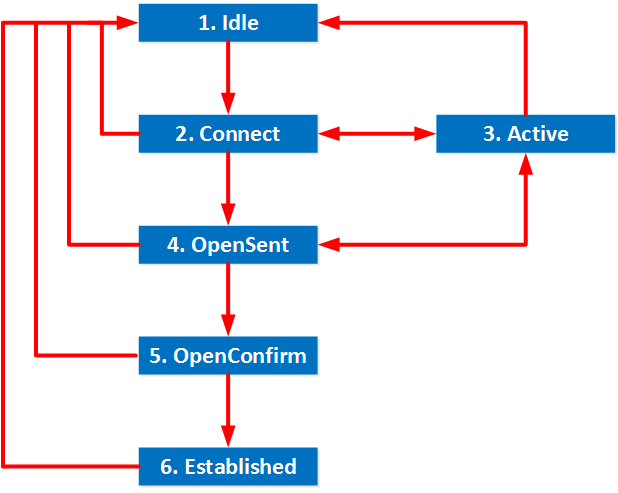
1️⃣ BGP routers establish TCP connection
2️⃣ Exchange OPEN messages
3️⃣ Establish neighbor relationship
4️⃣ Exchange routing updates
5️⃣ Apply routing policies
6️⃣ Best path selected
📌 BGP converges slowly but safely.
📦 BGP Message Types
Message | Purpose |
|---|---|
OPEN | Start BGP session |
UPDATE | Share routing info |
KEEPALIVE | Maintain connection |
NOTIFICATION | Report errors |
🧠 Why BGP Uses TCP?
Reliable delivery ✔️
Ordered updates ✔️
No packet loss ✔️
📌 Routing stability is critical for Internet.
🧠 Advantages of BGP
Scales to Internet size 🌍
Prevents routing loops
Supports routing policies
Very reliable
❌ Disadvantages of BGP
Complex configuration
Slow convergence
Requires expert knowledge
🧠 OSPF vs BGP
Feature | OSPF | BGP |
|---|---|---|
Scope | Intra-domain | Inter-domain |
Algorithm | Link State | Path Vector |
Metric | Cost | Policy |
Speed | Fast | Slow |
Usage | Enterprise | Internet |
🛡️ Security Issues in BGP
Route hijacking
Fake route advertisement
📌 Protection methods:
Route filtering
RPKI
Authentication
🧠 Memory Tricks
BGP = Big Global Paths 🌍
AS = Autonomous System
179 = BGP port
Policy > Distance
⭐ One-Line Summary
🔹 BGP is a path-vector routing protocol that controls how data is routed between autonomous systems on the Internet.