🤔 Why Do We Compare OSI and TCP/IP?
Both OSI Model and TCP/IP Model explain how data communication happens, but they are not the same.
📌 Students often get confused between:
Number of layers
Purpose
Practical usage
👉 This comparison will clear all confusion.
🧠 Basic Idea in One Line
📘 OSI Model → Explains how networking should work
🌍 TCP/IP Model → Actually makes networking work
🏗️ Overview of Both Models
🧱 OSI Model
7 layers
Conceptual / reference model
Developed for understanding & standardization
🌐 TCP/IP Model
4 layers
Practical model
Used in real-world Internet communication
🧭 Layer Structure Comparison
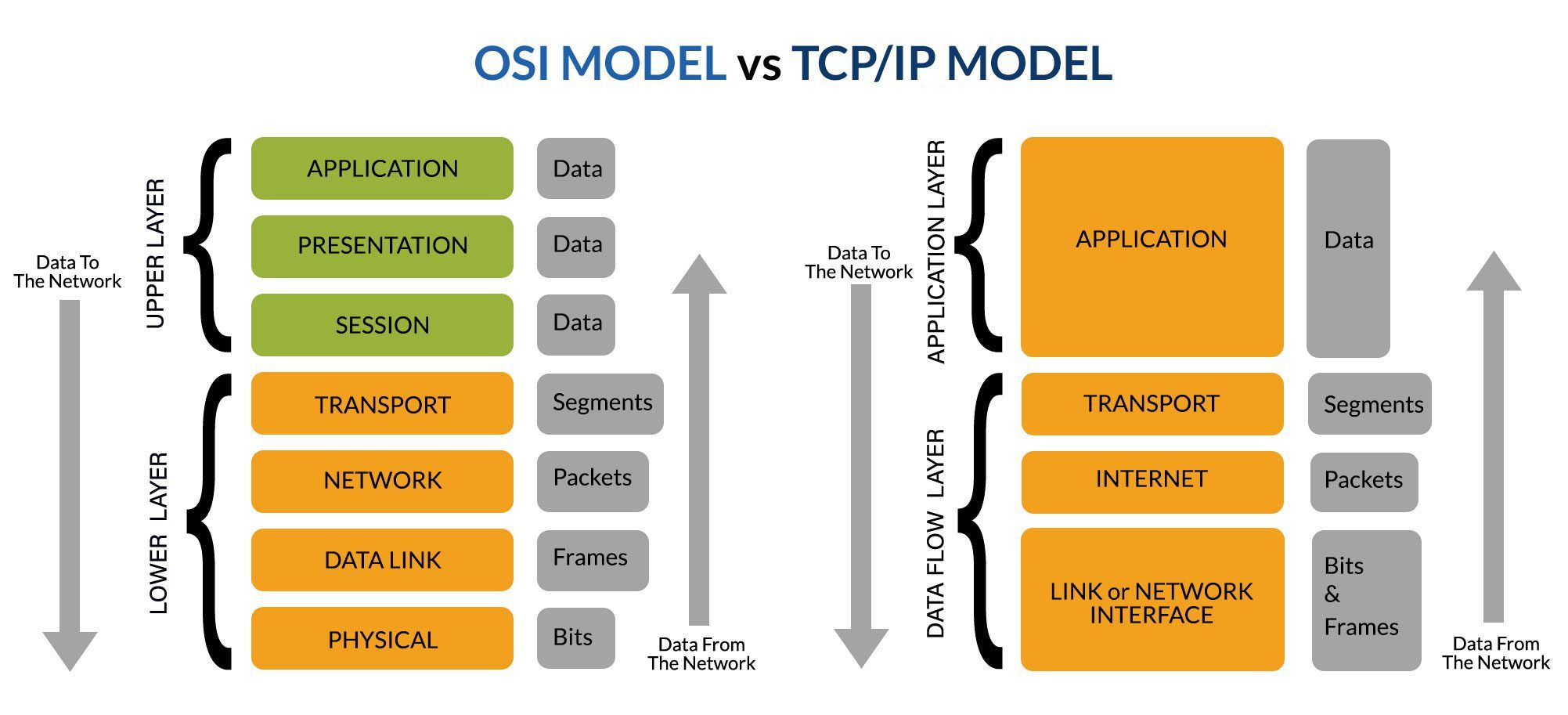
OSI Model (7 Layers) | TCP/IP Model (4 Layers) |
|---|---|
Application | Application |
Presentation | Application |
Session | Application |
Transport | Transport |
Network | Internet |
Data Link | Network Access |
Physical | Network Access |
📊 Detailed Comparison Table
Feature | OSI Model | TCP/IP Model |
|---|---|---|
Full Form | Open Systems Interconnection | Transmission Control Protocol / Internet Protocol |
Number of Layers | 7 | 4 |
Nature | Theoretical / Conceptual | Practical / Implemented |
Developed By | ISO | DARPA |
Year | 1984 | 1970s |
Usage | Learning & reference | Internet & real networks |
Flexibility | Less flexible | Highly flexible |
Layer Separation | Very clear | Not very clear |
Internet Support | ❌ Not used | ✅ Used |
Reliability | Depends on protocols | TCP provides reliability |
🧠 Layer-by-Layer Comparison
Criteria | OSI MODEL | TCP/IP MODEL |
|---|---|---|
🔝 Application Layer |
📌 Very detailed and clear. |
📌 Simpler but less descriptive. |
🚚 Transport Layer | ✔️ Same in both models
📌 TCP & UDP are used here. | ✔️ Same in both models
📌 TCP & UDP are used here. |
🌍 Network / Internet Layer |
|
📌 Functionally similar. |
🔌 Physical + Data Link Layers |
|
📌 OSI gives more detail, TCP/IP is simpler. |
🧠 Practical Difference (Very Important) |
|
👉 Without TCP/IP, Internet cannot work |
🛠️ Troubleshooting Perspective |
|
|
🌐 Real-Life Analogy | Blueprint of a building 🏢
| Actual building 🏠
|
⭐ Advantages Comparison
✅ OSI Model
Clear layer separation
Easy to understand
Better learning tool
✅ TCP/IP Model
Practical & reliable
Widely implemented
Supports internetworking
❌ Limitations Comparison
❌ OSI Model
Not implemented fully
Complex
Less practical
❌ TCP/IP Model
No session & presentation layers
Less detailed
🧠 One-Line Summary
🔹 OSI Model explains how networking should work, while TCP/IP Model explains how networking actually works.