🤔 What is SDN?
In traditional networks:
Each router/switch decides on its own
Configuration is manual
Network is hard to manage
📌 SDN changes this by separating decision-making from packet forwarding.
👉 The network becomes programmable and centrally controlled.
🧠 Simple Definition
📌 Software Defined Networking (SDN) is a networking approach where the control logic is separated from network devices and managed centrally using software.
🧠 One-Line Understanding
SDN = “The brain of the network is moved to software.”
🧠 Real-Life Analogy
🚦 Traffic Control System
Roads = switches
Cars = data packets
Traffic police control signals centrally
👉 Instead of each signal acting independently,
👉 One control room manages all signals.
📌 That control room = SDN Controller
🔀 Problem with Traditional Networking
Before SDN ❌:
❌ Manual device-by-device configuration
❌ Vendor-specific commands
❌ Slow changes
❌ Hard to scale
❌ Complex troubleshooting
📌 Managing large networks was painful.
🌟 Why SDN Was Introduced
SDN solves:
🚀 Scalability problems
⚙️ Complex management
🔄 Slow network changes
🧠 Lack of automation
📌 SDN makes networks flexible and intelligent.
🧱 Key Idea Behind SDN (MOST IMPORTANT ⭐)
🔑 Separation of Planes
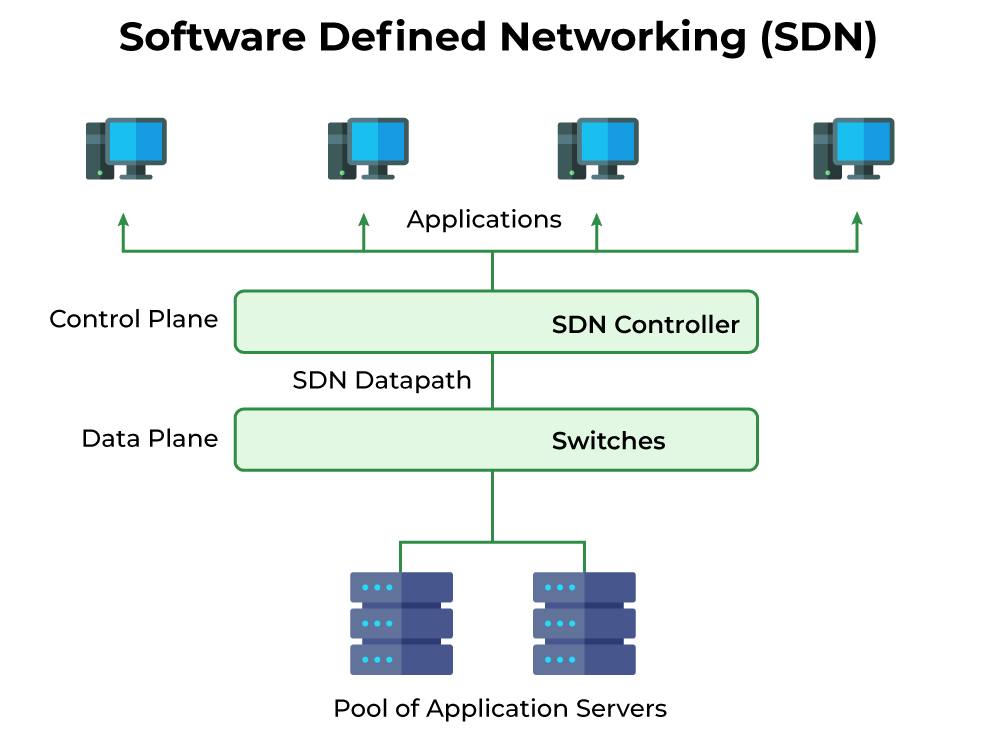
Traditional network:
Control plane + Data plane together ❌
SDN:
Control Plane → Centralized
Data Plane → Devices only forward packets ✅
🧩 Planes in Networking
🧠 Control Plane
Decides where packets should go
Routing decisions
Path selection
📦 Data Plane
Actually forwards packets
Fast & simple
👉 SDN separates these two clearly.
🏗️ SDN Architecture
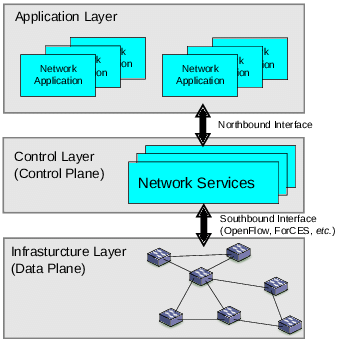
SDN has three main layers:
1️⃣ Application Layer
2️⃣ Control Layer
3️⃣ Infrastructure Layer
📱 Contains:
Network applications
Security apps
Load balancing apps
Monitoring tools
📌 Defines what the network should do.
Examples:
Firewall policies
QoS rules
Traffic engineering
📌 The brain of SDN.
Responsibilities:
Global network view
Decision-making
Policy enforcement
📌 Communicates with:
Applications (northbound)
Switches (southbound)
🔀 Contains:
Switches
Routers
Network devices
📌 Devices only forward packets based on controller instructions.
🔗 SDN Interfaces
⬆️ Northbound Interface (NBI)
📌 Between:
Application Layer ↔ Controller
Purpose:
Applications tell controller what they want
Examples:
REST APIs
⬇️ Southbound Interface (SBI)
📌 Between:
Controller ↔ Network Devices
Purpose:
Controller tells devices how to forward packets
Example:
OpenFlow ⭐
🔑 OpenFlow Protocol (Exam Favorite ⭐)
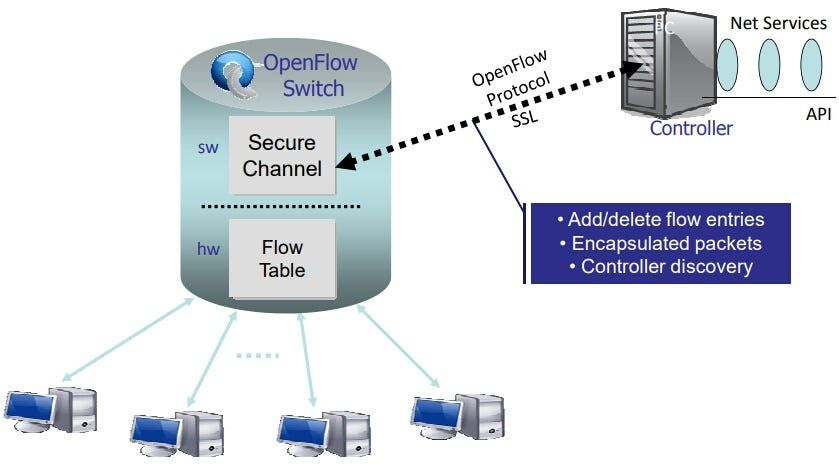
📌 OpenFlow is a southbound protocol.
It allows:
Controller to install flow rules
Switches to forward packets based on rules
🧠 Flow Table Concept
Each switch has a flow table:
Match fields (IP, port, MAC)
Action (forward, drop, modify)
🔄 How SDN Works (Step-by-Step)
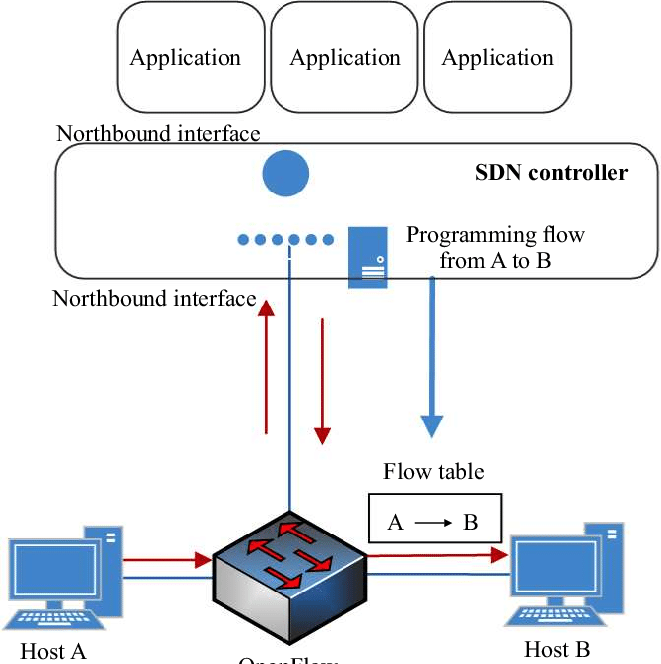
1️⃣ Packet arrives at switch
2️⃣ Switch checks flow table
3️⃣ No rule found → ask controller
4️⃣ Controller decides path
5️⃣ Controller installs rule
6️⃣ Switch forwards packets
📌 After this → packets flow fast without controller involvement.
⚖️ Traditional Networking vs SDN
Feature | Traditional Network | SDN |
|---|---|---|
Control | Distributed | Centralized |
Configuration | Manual | Automated |
Flexibility | Low | High |
Scalability | Difficult | Easy |
Vendor lock-in | High | Low |
🌍 Where is SDN Used? (Real World)
SDN is widely used in:
Data centers 🏢
Cloud networking ☁️
ISP networks 🌐
Campus networks 🎓
5G & modern networks 📶
🧠 Advantages of SDN
Centralized control 🧠
Easy automation ⚙️
Faster network changes ⚡
Better resource utilization
Improved security
❌ Challenges of SDN
Controller failure risk
Security of controller
Learning curve
Initial deployment cost
📌 Needs redundancy & security planning.
🛡️ SDN and Security (Quick Insight)
SDN improves security by:
Central policy enforcement
Dynamic firewall rules
Quick threat response
📌 But controller itself must be protected 🔐
🧠 Memory Tricks
SDN = Software decides 🧠
Controller = Brain
Switches = Workers
OpenFlow = Instruction channel
⭐ One-Line Summary
🔹 Software Defined Networking (SDN) separates network control from forwarding, enabling centralized, programmable, and flexible network management.