🤔 What is an Error in Data Communication?
When data is transmitted over a network, it travels as signals (electrical, light, or radio).
During transmission, data may get changed unintentionally.
📌 This unwanted change in data is called an Error.
🧠 Simple Example
Sender sends:
👉 1011001
Receiver receives:
👉 1011101 ❌ (one bit changed)
📌 This is a data transmission error.
⚠️ Why Do Errors Occur?
Errors can occur due to:
🔌 Electrical noise
📡 Signal interference
🌧️ Weather conditions
📉 Weak signals
💥 Hardware faults
👉 Errors are unavoidable, but they can be detected and corrected.
🎯 Why Error Detection & Correction is Needed
Without error control:
Wrong data is accepted ❌
System crashes ❌
Financial loss ❌
With error control:
Errors are detected ✔️
Data is corrected or retransmitted ✔️
Communication becomes reliable ✔️
🧭 Two Main Concepts
There are two important approaches:
1️⃣ Error Detection
2️⃣ Error Correction
Let’s understand both clearly 👇
🔍 Error Detection
🧠 What is Error Detection?
Error detection is the process of identifying whether data is corrupted or not during transmission.
📌 It detects the presence of error, but does not fix it.
🧠 What Happens After Detection?
Receiver informs sender
Sender retransmits the data
📌 Used where retransmission is possible.
🛠️ Common Error Detection Techniques
1️⃣ Parity Check
2️⃣ Checksum
3️⃣ Cyclic Redundancy Check (CRC)
🔢 1. Parity Check
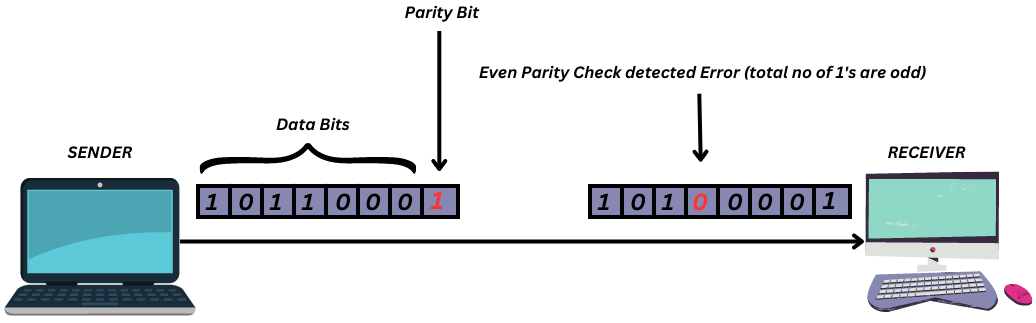
🧠 What is Parity Bit?
A parity bit is an extra bit added to data to make:
Number of 1s even (Even parity)
Number of 1s odd (Odd parity)
🧠 Example (Even Parity)
Data: 1011001 → number of 1s = 4
Parity bit added: 0
Transmitted: 10110010
✅ Advantages
Simple
Low overhead
❌ Disadvantages
Detects only single-bit errors
Cannot detect multiple-bit errors reliably
➕ 2. Checksum
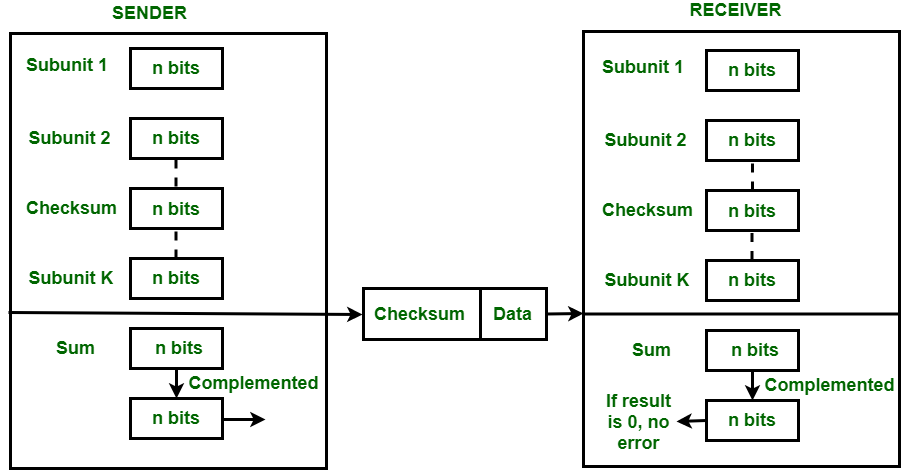
🧠 What is Checksum?
Checksum is a value calculated by:
Adding data bits
Sending the result with data
📌 Receiver recalculates checksum and compares.
🧠 Example
Sender:
Data blocks added → checksum generated
Receiver:
Adds received blocks
If result matches → no error
Else → error detected ❌
✅ Advantages
Better than parity
Simple to implement
❌ Disadvantages
Not 100% reliable
Some errors may go undetected
📌 Used in TCP, UDP.
🔁 3. Cyclic Redundancy Check (CRC)
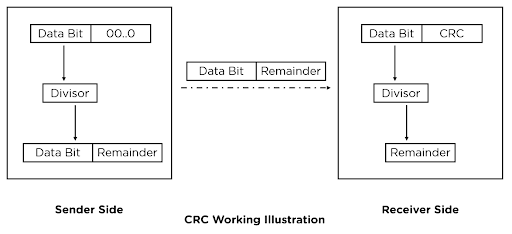
🧠 What is CRC?
CRC is a powerful error detection technique based on binary division.
📌 A fixed binary number called generator polynomial is used.
🧠 How CRC Works (Simple Steps)
1️⃣ Data is treated as binary number
2️⃣ Divided by generator polynomial
3️⃣ Remainder is calculated
4️⃣ Remainder is appended to data
5️⃣ Receiver repeats division
6️⃣ If remainder = 0 → no error ✔️
✅ Advantages
Detects burst errors
Very reliable
Widely used
❌ Disadvantages
More complex
Computational overhead
📌 Used in Ethernet, HDLC.
🛠️ Error Correction
🧠 What is Error Correction?
Error correction not only detects errors, but also fixes them at the receiver side.
📌 No need to retransmit data.
🧭 Types of Error Correction
1️⃣ Forward Error Correction (FEC)
2️⃣ Automatic Repeat reQuest (ARQ)
🚀 1. Forward Error Correction (FEC)
🧠 Explanation
Extra bits are added so receiver can:
Detect error
Correct error automatically
📌 Used where retransmission is not possible.
🧠 Example
Satellite communication 🛰️
Real-time audio/video 🎥
❌ Drawback
Adds more redundancy
Increases bandwidth usage
🔁 2. Automatic Repeat reQuest (ARQ)
🧠 Explanation
Error detected
Receiver requests retransmission
Sender resends data
📌 Most commonly used method.
🧩 Types of ARQ
Stop-and-Wait ARQ
Go-Back-N ARQ
Selective Repeat ARQ
📌 We’ll study these in Flow Control topic.
📊 Error Detection vs Error Correction
Feature | Error Detection | Error Correction |
|---|---|---|
Purpose | Detect error | Detect & fix |
Retransmission | Required | Not required |
Complexity | Low | High |
Overhead | Less | More |
🧠 Where Are These Techniques Used?
Parity → Simple systems
Checksum → TCP / UDP
CRC → Ethernet
FEC → Satellite
ARQ → Data Link & Transport layers
⭐ One-Line Summary
🔹 Error detection finds corrupted data, while error correction fixes errors to ensure reliable communication.