🤔 What is Congestion Control? (Basic Idea)
From the previous topic, we learned:
Congestion happens when too many packets overload the network.
📌 Congestion control is about preventing or reducing congestion before the network collapses.
🧠 Simple Definition
📌 Congestion control refers to techniques used to regulate the flow of data in a network so that traffic load does not exceed network capacity.
🧠 Congestion Control vs Flow Control
Aspect | Congestion Control | Flow Control |
|---|---|---|
Controls | Network load | Receiver capacity |
Scope | Entire network | End-to-end |
Example | TCP congestion control | TCP sliding window |
📌 Congestion control ≠ Flow control
🧭 Where is Congestion Control Applied?
Congestion control can be applied at:
Network layer (routers)
Transport layer (TCP)
🎯 Goals of Congestion Control
Congestion control aims to:
🚫 Prevent network collapse
📦 Reduce packet loss
⏱️ Reduce delay
⚖️ Ensure fairness among users
📈 Improve throughput
🧩 Classification of Congestion Control Techniques
Congestion control techniques are broadly divided into:
1️⃣ Open-Loop Congestion Control
2️⃣ Closed-Loop Congestion Control
📌 This classification is VERY IMPORTANT⭐
🔓 1. Open-Loop Congestion Control (Prevention)
🧠 What is Open-Loop Congestion Control?
📌 In open-loop control:
Decisions are made before congestion occurs
No feedback from the network
Focus is on prevention
👉 “Prevent congestion rather than cure it”
🧠 Real-Life Analogy
🚦 Traffic Rules
Speed limits
Lane discipline
Traffic signals
👉 These rules prevent traffic jams before they happen.
🧩 Open-Loop Congestion Control Techniques
🧠 Explanation
Network checks if it can handle new traffic
If overloaded → new connection denied
📌 Used in:
ATM networks
QoS-based systems
✅ Advantage
Prevents overload
❌ Disadvantage
New users may be blocked
🧠 Explanation
Traffic shaping controls:
Rate of data transmission
Smooths bursty traffic
Two common algorithms:
🚰 a) Leaky Bucket Algorithm
Bucket leaks at constant rate
Excess packets are discarded
📌 Ensures steady traffic flow.
🪙 b) Token Bucket Algorithm
Tokens generated at fixed rate
Packet sent only if token available
📌 Allows controlled bursts ✔️
🧠 Explanation
Resources (bandwidth, buffer) reserved in advance
Used in multimedia applications
📌 Example:
Video conferencing 🎥
🧠 Explanation
Routes selected based on current traffic
Avoids congested paths
📌 Helps balance load.
🧠 Explanation
Determines order of packet transmission
Examples:
FIFO (First In First Out)
Priority scheduling
Weighted Fair Queuing
📌 Ensures fairness ⚖️
🔁 2. Closed-Loop Congestion Control (Feedback-Based)
🧠 What is Closed-Loop Congestion Control?
📌 In closed-loop control:
Congestion is detected
Feedback is sent
Action is taken to reduce congestion
👉 “Detect → Feedback → Adjust”
🧠 Real-Life Analogy
🚘 Traffic Police
Detect traffic jam
Redirect vehicles
Reduce congestion
🧩 Closed-Loop Congestion Control Techniques
🧠 Explanation
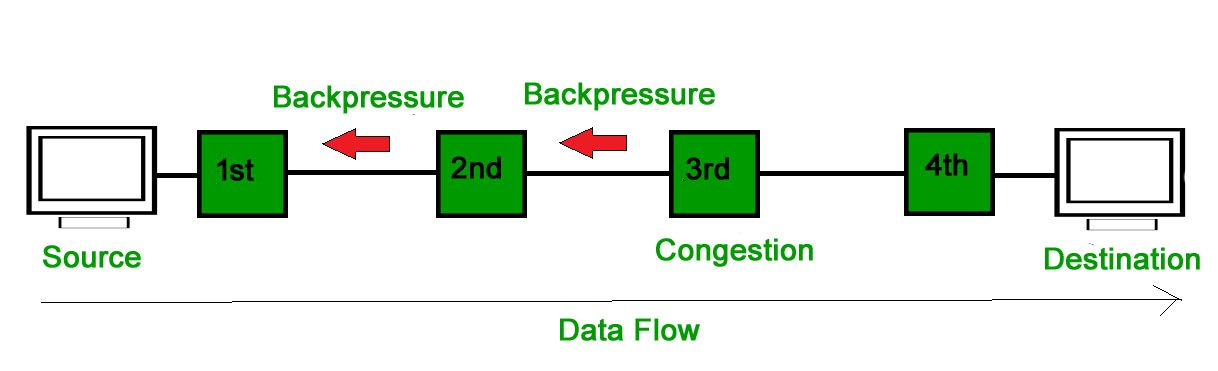
Congested node tells upstream nodes to slow down
Propagates backward
📌 Used in:
Virtual circuits
🧠 Explanation
Router sends special packet to sender
Asks sender to reduce transmission rate
📌 Rarely used today.
🧠 Explanation
Router marks packets instead of dropping them
Receiver informs sender
Sender reduces rate
📌 Prevents packet loss ✔️
🧠 Explanation
Router deliberately drops packets
Reduces load immediately
📌 Last-resort technique ❗
TCP uses multiple mechanisms:
🐢 a) Slow Start
Start with small congestion window
Increase exponentially
📌 Prevents sudden overload.
📈 b) Congestion Avoidance
Increase window slowly (linear)
Avoids congestion region
🚫 c) Fast Retransmit
Retransmit lost packet quickly
Based on duplicate ACKs
🔁 d) Fast Recovery
Avoids going back to slow start
Improves performance
⚖️ Open-Loop vs Closed-Loop
Feature | Open-Loop | Closed-Loop |
|---|---|---|
Feedback | ❌ No | ✅ Yes |
Focus | Prevention | Detection & recovery |
Reaction | Proactive | Reactive |
Example | Traffic shaping | TCP congestion control |
🧠 Congestion Control Summary Table
Technique | Type |
|---|---|
Admission control | Open-loop |
Traffic shaping | Open-loop |
Choke packet | Closed-loop |
ECN | Closed-loop |
TCP congestion control | Closed-loop |
🧠 Memory Tricks
Open-loop = No feedback 🔓
Closed-loop = Feedback 🔁
TCP = Smart congestion control 🧠
⭐ One-Line Summary
🔹 Congestion control techniques regulate data flow using preventive (open-loop) and feedback-based (closed-loop) methods to maintain network performance.