🤔 What is Network Congestion? (Basic Idea)
Imagine a highway 🚗🚗🚗 with too many vehicles at the same time.
Vehicles move slowly
Traffic jams occur
Accidents may happen
📌 Network congestion is exactly the same—but with data packets instead of vehicles.
🧠 Simple Definition
📌 Network congestion occurs when the demand for network resources exceeds the available capacity, causing packet delay, packet loss, and reduced performance.
🧠 One-Line Understanding
Too much data + limited network resources = Congestion
🧠 Why Congestion is a Serious Problem
Congestion leads to:
⏳ High delay (latency)
📉 Low throughput
📦 Packet loss
🔁 Retransmissions
😡 Poor user experience
📌 Severe congestion can cause network collapse.
🧭 Where Does Congestion Occur?
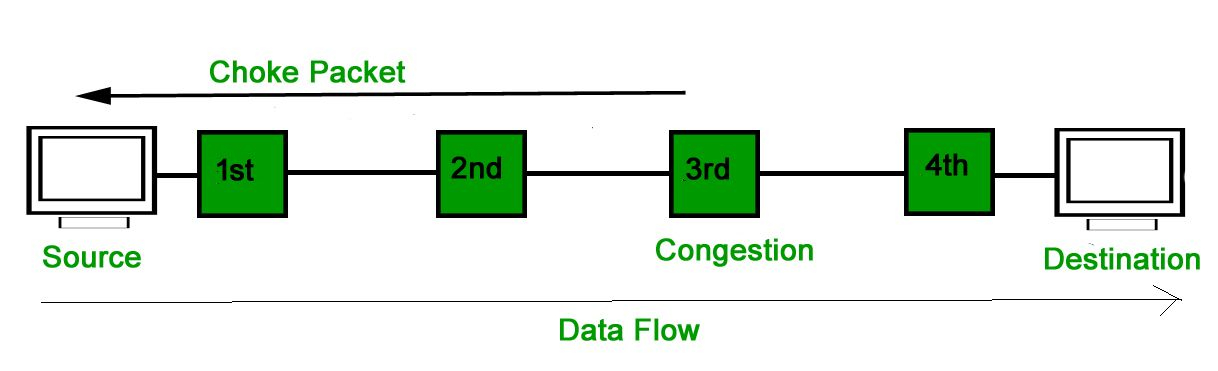
Congestion can occur at:
Routers
Switches
Links
Servers
📌 Especially at bottleneck points.
🎯 Main Causes of Network Congestion
Let’s now understand each cause deeply, with examples 👇
📶 1. High Traffic Load (Too Many Packets)
🧠 What Does This Mean?
Too many users send data at the same time
Network cannot handle the load
📌 Example:
Online exam 🧑🎓
IPL match streaming 🏏
Sale on e-commerce website 🛒
❌ Effect
Router queues overflow
Packets dropped
📌 Most common cause of congestion ⭐
⚙️ 2. Insufficient Bandwidth
🧠 What is Bandwidth?
📌 Bandwidth is the maximum data capacity of a link.
🧠 Cause Explained
Data demand > Link capacity
Packets arrive faster than they can be transmitted
📌 Example:
1 Gbps demand on a 10 Mbps link
❌ Effect
Long delays
Packet loss
🧱 3. Bottleneck Links
🧠 What is a Bottleneck?
📌 A bottleneck is the slowest link in the network path.
🧠 Example
LAN → Fast router → Slow WAN link
📌 Even if most of network is fast, one slow link causes congestion.
🧠 4. Limited Router Buffer (Queue Overflow)
🧠 What is Router Buffer?
Routers store packets temporarily in queues
Buffer size is limited
🧠 Cause Explained
Too many incoming packets
Buffer becomes full
New packets are dropped
📌 Called buffer overflow.
❌ Effect
Packet loss
Retransmissions
🔁 5. Excessive Retransmissions
🧠 What Happens?
Packets lost due to congestion
Sender retransmits packets
Retransmissions increase traffic further
📌 This creates a vicious cycle 🔄
❌ Effect
Congestion worsens
Network performance collapses
🧪 6. Poor Network Design
🧠 Examples of Bad Design
No load balancing
Improper routing
Single point of failure
📌 Poor design = inefficient traffic handling.
❌ Effect
Unnecessary congestion
Uneven traffic distribution
📡 7. Slow or Faulty Network Devices
🧠 What Does This Mean?
Old routers
Low-performance switches
Hardware failures
📌 These devices process packets slowly.
❌ Effect
Packet queues grow
Congestion increases
🌐 8. Sudden Bursts of Traffic
🧠 What is Burst Traffic?
Traffic spikes suddenly
Network not prepared
📌 Example:
Viral video 📹
Breaking news 📰
❌ Effect
Temporary congestion
Packet loss
🧠 9. Lack of Traffic Control Mechanisms
🧠 Explanation
No congestion control
No traffic shaping
No priority handling
📌 Network treats all packets equally—even when overloaded.
❌ Effect
Critical traffic suffers
No fairness
⚖️ Cause → Effect Mapping
Cause | Effect |
|---|---|
High traffic | Delay & packet loss |
Low bandwidth | Congestion |
Small buffer | Packet drops |
Retransmissions | Congestion collapse |
Poor design | Bottlenecks |
🧠 Congestion vs Flow Control (Quick Note)
Feature | Congestion | Flow Control |
|---|---|---|
Scope | Network-wide | Sender–receiver |
Cause | Network overload | Receiver limitation |
Example | Router queue overflow | Receiver buffer full |
📌 Congestion ≠ Flow Control
🧠 Real-Life Internet Example
📶 During peak hours:
Many users online
ISP links overloaded
Internet becomes slow
👉 This is network congestion.
🧠 Memory Tricks
Congestion = Crowd 🚗🚗🚗
Bottleneck = Narrow road 🛣️
More traffic + less capacity = Jam
⭐ One-Line Summary
🔹 Network congestion occurs when excessive traffic overwhelms network resources, leading to delay, packet loss, and reduced performance.