🤔 What is Traffic Shaping? (Basic Idea)
In networks, data does not arrive smoothly:
Sometimes traffic comes in bursts
Sudden bursts cause congestion
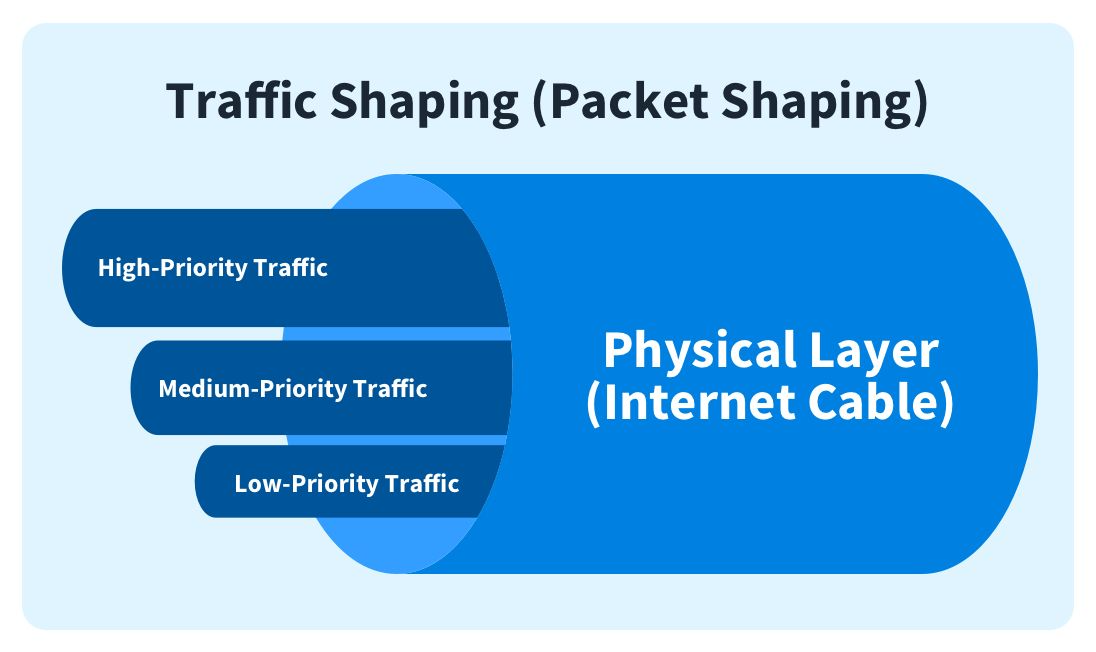
📌 Traffic shaping controls the rate at which packets are sent into the network.
👉 It smoothens traffic so the network does not get overloaded.
🧠 Simple Definition
📌 Traffic shaping is a congestion control technique that regulates the data transmission rate by controlling how packets are sent into the network.
🧠 One-Line Understanding
Traffic shaping makes fast and bursty traffic behave in a smooth and controlled way.
🧠 Real-Life Analogy
🚰 Water Tank Example
Water enters tank irregularly
Outlet releases water at a steady rate
👉 Traffic shaping works exactly like this:
Input = bursty packets
Output = smooth packet flow
🎯 Why Traffic Shaping is Needed
Traffic shaping helps to:
🚫 Prevent congestion
📉 Reduce packet loss
⏱️ Reduce delay
⚖️ Ensure fairness
🎥 Support real-time traffic (voice/video)
📌 It is a preventive (open-loop) congestion control technique.
🧭 Where is Traffic Shaping Applied?
Traffic shaping is applied at:
Routers
Switches
ISP edge devices
📌 Usually at network edges, not core.
🧩 Main Traffic Shaping Algorithms
Traffic shaping is mainly implemented using:
1️⃣ Leaky Bucket Algorithm
2️⃣ Token Bucket Algorithm
🚰 1. Leaky Bucket Algorithm
🧠 Basic Idea
Imagine a bucket with a small hole
Water leaks at a constant rate
If bucket overflows → water is lost
👉 Packets behave like water 💧
⚙️ How Leaky Bucket Works (Step-by-Step)
1️⃣ Incoming packets enter the bucket (queue)
2️⃣ Bucket has fixed capacity
3️⃣ Packets leave bucket at constant rate
4️⃣ If bucket is full → extra packets are discarded
📌 Output traffic becomes smooth and constant.
🧾 Key Characteristics
Constant output rate
No traffic bursts allowed
Excess packets dropped
✅ Advantages of Leaky Bucket
Simple to implement
Excellent congestion prevention
Smooth traffic flow
❌ Disadvantages of Leaky Bucket
Packet loss during bursts
Not suitable for real-time traffic
No flexibility
📌 Use Case
Constant bit-rate applications
Old traffic systems
🪙 2. Token Bucket Algorithm
🧠 Basic Idea
Tokens are generated at a fixed rate
Tokens are stored in a bucket
To send a packet → token required
👉 No token = no packet sent 🚫
⚙️ How Token Bucket Works (Step-by-Step)
1️⃣ Tokens generated periodically
2️⃣ Tokens stored up to bucket capacity
3️⃣ Packet arrives
4️⃣ If token available → packet sent
5️⃣ If no token → packet waits or is dropped
📌 Allows controlled bursts ✔️
🧾 Key Characteristics
Average rate is controlled
Bursty traffic allowed
More flexible than leaky bucket
✅ Advantages of Token Bucket
Supports bursty traffic
Ideal for multimedia (video, VoIP)
Better bandwidth utilization
❌ Disadvantages of Token Bucket
More complex
Needs careful tuning
📌 Use Case
Modern networks
QoS systems
Real-time applications
⚖️ Leaky Bucket vs Token Bucket
Feature | Leaky Bucket | Token Bucket |
|---|---|---|
Output rate | Constant | Variable |
Bursts allowed | ❌ No | ✅ Yes |
Packet loss | High during bursts | Low |
Flexibility | Low | High |
Real-time apps | ❌ Poor | ✅ Good |
🧠 Traffic Shaping vs Traffic Policing (Quick Note)
Feature | Traffic Shaping | Traffic Policing |
|---|---|---|
Excess packets | Delayed | Dropped |
Buffer used | ✅ Yes | ❌ No |
Smooth output | ✅ Yes | ❌ No |
Congestion prevention | Strong | Moderate |
📌 Traffic shaping is gentler than policing.
🧠 Traffic Shaping in QoS (Quality of Service)
Traffic shaping helps:
Voice packets get priority 📞
Video streams stay smooth 🎥
Data downloads adapt automatically 📦
📌 Essential for QoS implementation.
🧠 Advantages of Traffic Shaping
Prevents congestion
Reduces packet loss
Improves network stability
Ensures fair usage
❌ Limitations of Traffic Shaping
Requires buffers (memory)
Adds delay
Needs correct configuration
🧠 Memory Tricks
Leaky Bucket = Leak at constant rate 🚰
Token Bucket = Spend tokens 🪙
Bursts allowed = Token Bucket
⭐ One-Line Summary
🔹 Traffic shaping regulates data transmission using algorithms like leaky bucket and token bucket to prevent congestion and ensure smooth network flow.