Agile was born out of the Agile Manifesto (2001), which prioritized four key values:
Individuals and interactions over processes and tools.
Working software over comprehensive documentation.
Customer collaboration over contract negotiation.
Responding to change over following a plan.
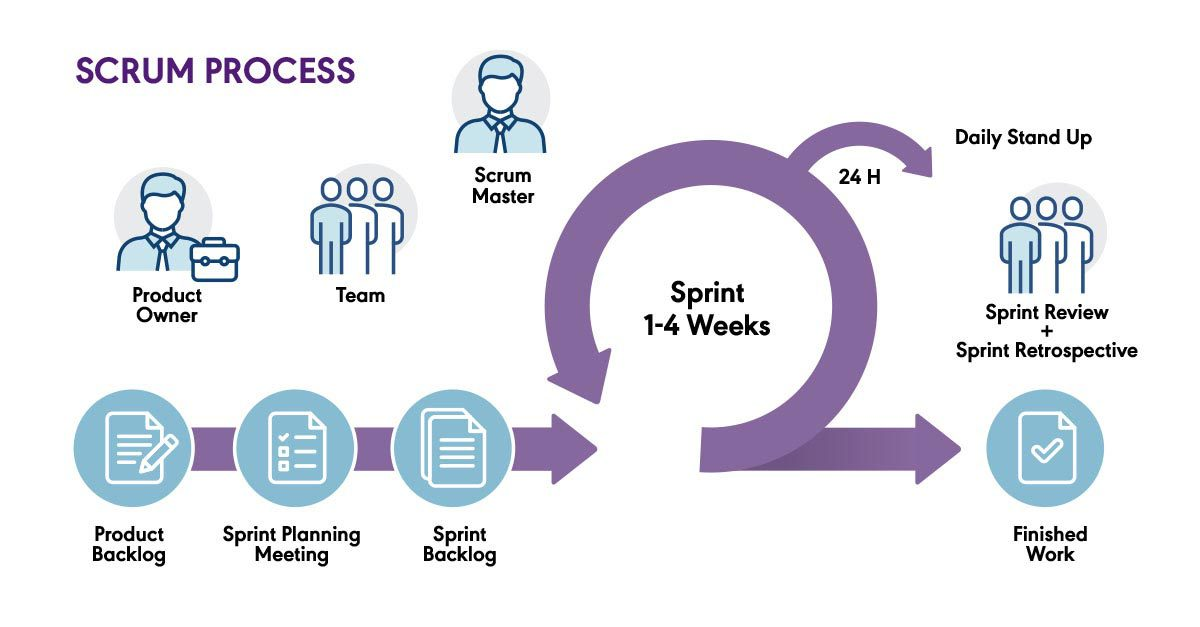
🔄 The Agile Workflow
In Agile, software is developed in iterations. Each iteration is a mini-project that lasts 1–4 weeks and results in a "shippable" increment of the software.
🏉 What is Scrum?
Scrum is the most popular "framework" used to implement Agile. It organizes the team into specific roles and meetings (events) to ensure work gets done quickly and transparently.
👥 The Scrum Roles
Product Owner: The "voice of the customer." They decide what needs to be built and prioritize the work.
Scrum Master: The "coach." They remove obstacles for the team and ensure Scrum rules are followed.
The Development Team: The people doing the work (Engineers, Designers, Testers).
📅 The Scrum Events (The Process)
Product Backlog: A master list of every feature, bug fix, and requirement for the entire project.
Sprint Planning: At the start of a Sprint, the team picks items from the Backlog to finish in the next 2 weeks.
The Sprint: A timed period (usually 2 weeks) where the team builds the features.
Daily Stand-up: A 15-minute meeting where the team syncs up: "What did I do yesterday? What will I do today? Is anything blocking me?"
Sprint Review: A demo for the customer to show what was built.
Sprint Retrospective: A team meeting to discuss: "How can we work better in the next Sprint?"
✅ Advantages of Agile/Scrum
Adaptability: If the market changes or the client changes their mind, the team can pivot in just 2 weeks.
Continuous Feedback: Since the customer sees the software every 2 weeks, there are no "surprises" at the end.
High Quality: Testing is integrated into every day of the Sprint, not left for the end.
Employee Morale: Teams are self-organizing and have more "say" in how work is done.
❌ Disadvantages
Scope Creep: Without a fixed end-date, projects can go on forever if the Product Owner keeps adding features.
Lack of Documentation: Because the focus is on "Working Software," technical documentation often gets ignored.
Resource Intensive: Requires highly committed team members and active participation from the customer.
⚖️ Waterfall vs. Agile: The "Meal" Analogy
Waterfall: You order a 5-course meal. You wait 1 hour and then everything is served at once. If the soup is cold, it’s too late to change the whole order easily.
Agile: The waiter brings you a small appetizer. You taste it, give feedback ("too salty!"), and based on that, the chef prepares the next small plate perfectly.