🤔 What is OSPF? (Basic Idea)
In large networks:
Routers must quickly find the best path
Network changes should be reflected fast
Routing should be scalable and reliable
📌 OSPF is designed to solve the limitations of RIP.
🧠 Simple Definition
📌 OSPF (Open Shortest Path First) is a link-state routing protocol that finds the shortest path to a destination using cost as a metric.
🧠 Why OSPF is Needed
RIP problems ❌:
Max 15 hops
Slow convergence
Not scalable
OSPF advantages ✅:
Supports large networks
Fast convergence
No hop limit
Uses bandwidth-based cost
👉 OSPF is used in modern enterprise networks.
🧠 Real-Life Analogy
🗺️ Google Maps Example
You see the entire road map
Choose the shortest & fastest route
Traffic updates are fast
👉 OSPF works the same way:
Routers know the full network topology
Choose the best path
🧭 Where Does OSPF Work?
OSPF is a Network Layer routing protocol
Uses IP protocol number 89
Does NOT use TCP or UDP
🧠 Type of Routing Algorithm Used
📌 OSPF uses Link-State Routing Algorithm
Protocol | Routing Type |
|---|---|
RIP | Distance Vector |
OSPF | Link State |
🧮 Routing Metric in OSPF
📌 Cost is based on bandwidth
Formula:
Cost = Reference Bandwidth / Interface Bandwidth👉 Lower cost = Better path
🧠 Key OSPF Concepts
📌 LSAs contain:
Link information
Cost
Neighbor data
👉 Routers exchange LSAs to build topology.
📌 LSDB:
Stores all LSAs
Same LSDB for all routers in an area
Represents full network map
📌 OSPF uses Dijkstra’s Algorithm to calculate shortest paths.
👉 Result is stored in the routing table.
🧩 OSPF Areas
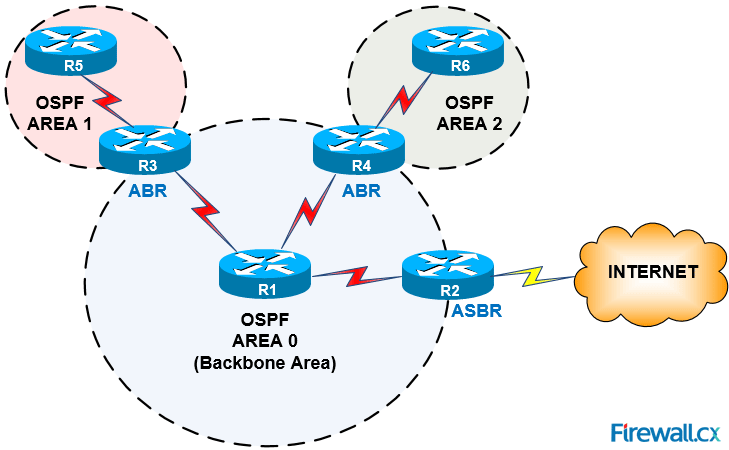
OSPF uses hierarchical routing.
🧠 What is an Area?
📌 An area is a logical grouping of routers.
Purpose:
Reduce routing overhead
Improve scalability
🟢 Area 0 (Backbone Area)
📌 Mandatory area
📌 All other areas must connect to Area 0
🔵 Non-Backbone Areas
Area 1, Area 2, etc.
Connect to Area 0 via ABR
🧠 Types of OSPF Routers
Router Type | Description |
|---|---|
Internal Router | Inside one area |
Backbone Router | Connected to Area 0 |
ABR | Area Border Router |
ASBR | Connects OSPF to other protocols |
🔄 How OSPF Works (Step-by-Step)
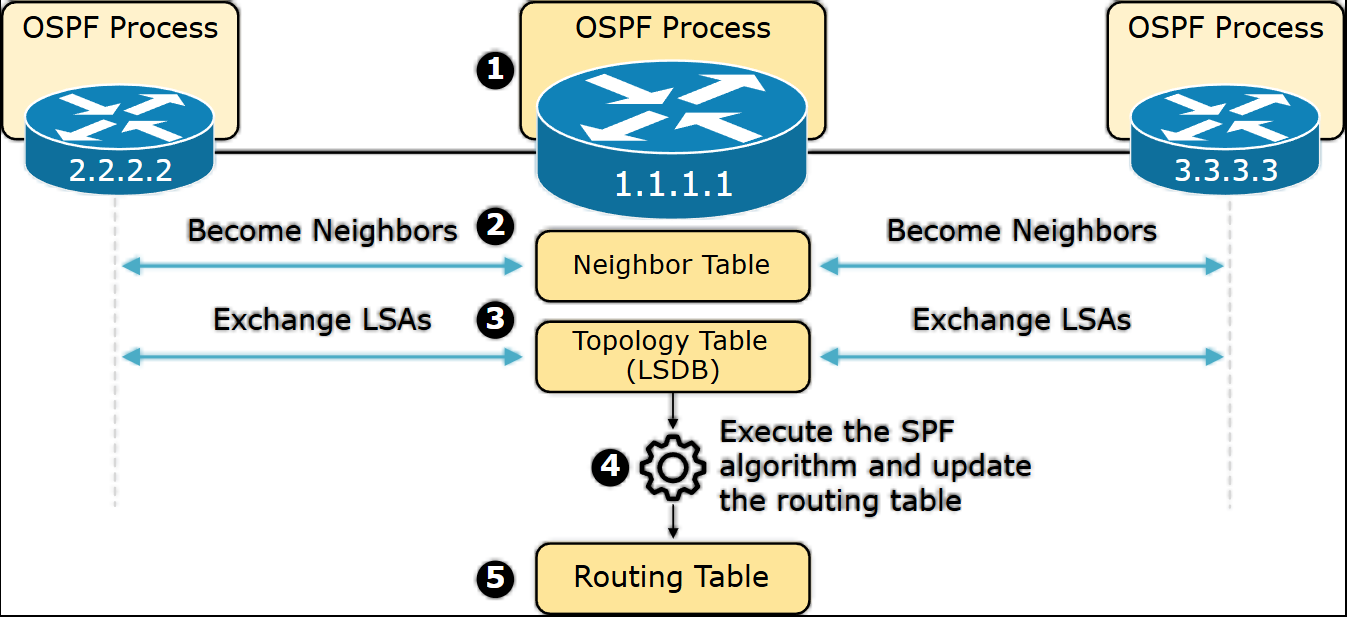
1️⃣ Routers send Hello packets
2️⃣ Neighbors discovered
3️⃣ LSAs exchanged
4️⃣ LSDB built
5️⃣ SPF algorithm runs
6️⃣ Best routes added to routing table
📌 Convergence is very fast ⚡
📦 OSPF Packet Types
Packet Type | Purpose |
|---|---|
Hello | Discover neighbors |
DBD | Database Description |
LSR | Link State Request |
LSU | Link State Update |
LSAck | Acknowledgement |
🧠 OSPF Versions
🟢 OSPFv2
Used for IPv4
🔵 OSPFv3
Used for IPv6
⚖️ OSPF vs RIP
Feature | RIP | OSPF |
|---|---|---|
Routing Type | Distance Vector | Link State |
Metric | Hop count | Cost |
Max Hop | 15 | No limit |
Convergence | Slow | Fast |
Scalability | Low | High |
Usage | Small networks | Large networks |
🧠 Advantages of OSPF
Fast convergence ⚡
Supports large networks 🌍
No hop limitation
Efficient bandwidth usage
❌ Disadvantages of OSPF
Complex configuration
More memory & CPU usage
Requires skilled administration
🧠 Memory Tricks
OSPF = Open Shortest Path First
Cost = Bandwidth
Area 0 = Backbone 🦴
LSA = Link information
⭐ One-Line Summary
🔹 OSPF is a link-state routing protocol that uses cost and Dijkstra’s algorithm to find the shortest and most efficient paths in large networks.