🤔 What is Packet Loss? (Basic Idea)
When data is sent over a network:
It is broken into small packets
These packets travel independently
📌 If some packets do not reach the destination, it is called packet loss.
🧠 Simple Definition
📌 Packet loss occurs when one or more data packets fail to reach their destination during transmission across a network.
🧠 One-Line Understanding
Packet loss = “Some data packets disappear on the way.”
🧠 Real-Life Analogy
📦 Courier Example
You send 10 parcels
Only 8 are delivered
2 are missing ❌
👉 Missing parcels = packet loss
🧭 Where Does Packet Loss Occur?
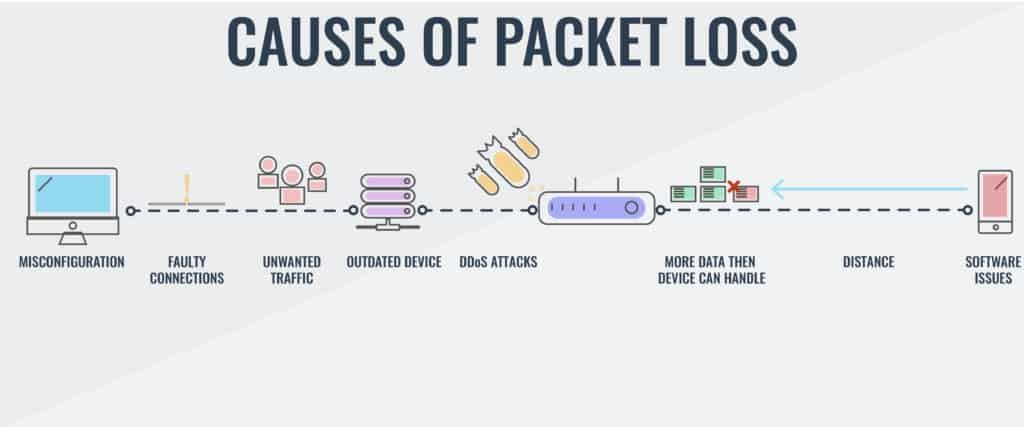
Packet loss can occur at:
Routers
Switches
Wireless links
End devices
📌 Especially where congestion or errors occur.
🎯 Why Packet Loss Is a Serious Problem
Packet loss causes:
📉 Reduced throughput
🔁 Retransmissions
⏱️ Increased delay
📞 Voice call distortion
🎥 Video freezing
📌 In real-time apps, packet loss is very damaging.
🧩 Main Causes of Packet Loss
🚦 1. Network Congestion
Too many packets arrive at a router
Router buffer becomes full
Extra packets are dropped
📌 Most common cause of packet loss ⭐
📉 2. Buffer Overflow (Queue Overflow)
Router queues have limited size
When full → incoming packets dropped
📌 Happens during traffic spikes.
📡 3. Transmission Errors
Noise, interference, weak signals
Bits get corrupted
Packet discarded due to checksum failure
📌 Common in wireless networks.
🖥️ 4. Faulty or Overloaded Network Devices
Old routers
Slow switches
CPU overload
📌 Devices fail to process packets fast enough.
🔌 5. Link Failures
Cable cut
Interface down
Temporary outages
📌 Packets sent during failure are lost.
⚙️ 6. Software Bugs or Misconfiguration
Wrong MTU settings
Firewall misrules
Routing issues
📌 Leads to unnecessary packet drops.
📶 7. Wireless Interference
Signal overlap
Obstacles
Distance
📌 Wireless links have higher packet loss than wired.
🧠 Packet Loss in TCP vs UDP
🔁 Packet Loss in TCP
TCP detects loss
Retransmits lost packets
Reduces congestion window
📌 Result:
Reliability ✔️
Lower throughput ❌
⚡ Packet Loss in UDP
No retransmission
Lost packets ignored
📌 Result:
Faster ✔️
Data gaps ❌
👉 Voice/video prefer UDP, tolerate small loss.
⚖️ Impact of Packet Loss on Applications
Application | Impact |
|---|---|
File download | Slower (retransmissions) |
Web browsing | Delay |
Voice call | Choppy audio |
Video streaming | Freezing / pixelation |
Online gaming | Lag |
📊 Acceptable Packet Loss Levels (Approx.)
Application | Acceptable Loss |
|---|---|
File transfer | ~0% |
Web browsing | <1% |
Voice (VoIP) | <1–2% |
Video streaming | <1% |
Gaming | <0.5% |
📌 Real-time apps are very sensitive.
🧠 Packet Loss vs Delay vs Throughput (Quick View)
Metric | Meaning |
|---|---|
Delay | Time taken |
Throughput | Data delivered |
Packet Loss | Data dropped |
📌 Packet loss reduces throughput and increases delay.
🔍 How Packet Loss Is Detected
🧪 Ping Command
Missing replies → packet loss %
🧭 Traceroute
Identifies loss at specific hops
📊 Network Monitoring Tools
SNMP
NetFlow
🛠️ How to Reduce Packet Loss
✅ 1. Reduce Congestion
Increase bandwidth
Apply traffic shaping
Use QoS
✅ 2. Improve Network Hardware
Upgrade routers & switches
Increase buffer size (carefully)
✅ 3. Optimize Wireless Networks
Stronger signals
Better placement
Less interference
✅ 4. Proper Configuration
Correct MTU
Efficient routing
Firewall tuning
✅ 5. Use Error Control Mechanisms
TCP retransmissions
Forward Error Correction (FEC)
🧠 Memory Tricks
Packet loss = Missing parcels 📦❌
Congestion = Drops
Wireless = More loss 📡
TCP retries, UDP ignores
⭐ One-Line Summary
🔹 Packet loss occurs when data packets fail to reach their destination due to congestion, errors, or failures, leading to reduced network performance.