🤔 What is IPv4 Addressing? (Basic Idea)
To communicate over a network, every device must have an address.
📌 At the Network Layer, this address is called an IP address.
👉 IPv4 (Internet Protocol version 4) is the most widely used addressing scheme on the Internet and local networks.
🧠 Simple Definition
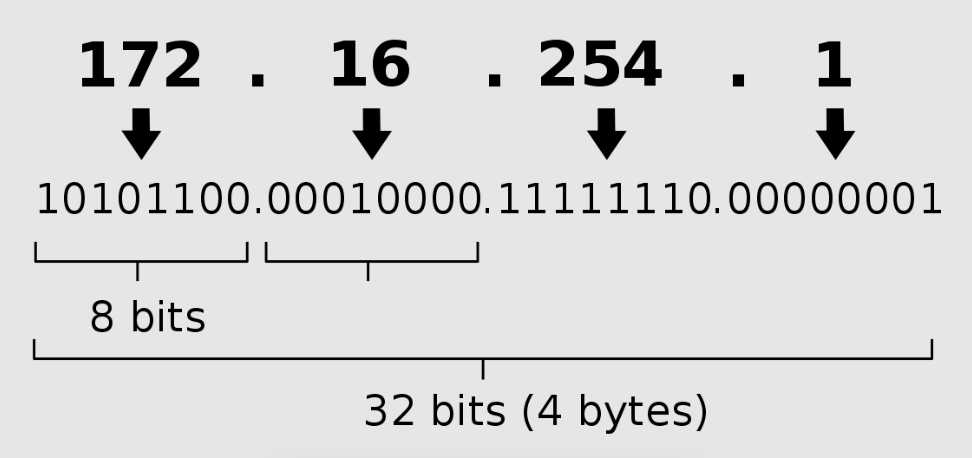
📌 IPv4 addressing is a method of identifying devices on a network using 32-bit logical addresses written in dotted decimal format.
🔢 Structure of an IPv4 Address
🔹 Key Points
Length: 32 bits
Divided into 4 parts (octets)
Each octet = 8 bits
Total values per octet: 0–255
📌 Written as:
A.B.C.D
👉 Example:
192.168.1.10
🧠 Binary Representation
IP Address: 192.168.1.10
192 →
11000000168 →
101010001 →
0000000110 →
00001010
📌 Total = 32 bits
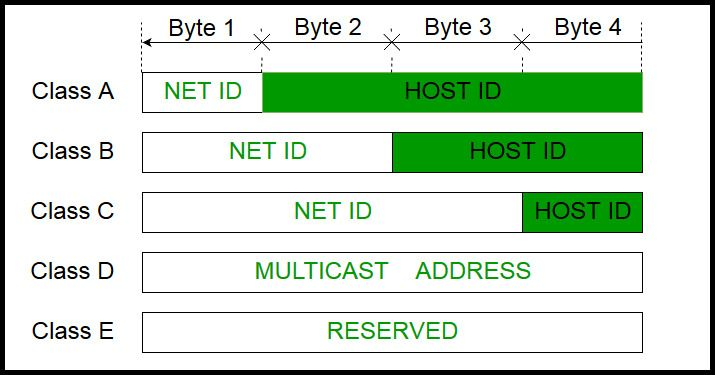
🧩 Two Parts of an IPv4 Address
An IPv4 address is divided into:
1️⃣ Network ID
2️⃣ Host ID
🌍 Network ID
Identifies the network
Same for all devices in that network
🖥️ Host ID
Identifies the specific device
Unique within the network
📌 Routers use Network ID to forward packets.
🧠 Why Divide IP Address Like This?
Think of a postal address 📮:
Country + City + Area → Network ID
House Number → Host ID
👉 Same logic is used in IPv4 addressing.
🏷️ Classful IPv4 Addressing
IPv4 addresses are traditionally divided into five classes:
Class A
Class B
Class C
Class D
Class E
📌 This classification is based on first octet value.
📊 IPv4 Address Classes (Overview Table)
Class | Range (1st Octet) | Network Bits | Host Bits | Usage |
|---|---|---|---|---|
A | 1 – 126 | 8 | 24 | Very large networks |
B | 128 – 191 | 16 | 16 | Medium networks |
C | 192 – 223 | 24 | 8 | Small networks |
D | 224 – 239 | – | – | Multicast |
E | 240 – 255 | – | – | Experimental |
🅰️ Class A Addressing
🔹 Characteristics
First octet: 1–126
Format:
N.H.H.HNetwork bits: 8
Host bits: 24
📌 Example:
10.20.30.40
🧠 Capacity
Networks: 126
Hosts per network: 16,777,214
📌 Used by large organizations.
🅱️ Class B Addressing
🔹 Characteristics
First octet: 128–191
Format:
N.N.H.HNetwork bits: 16
Host bits: 16
📌 Example:
172.16.5.10
🧠 Capacity
Networks: 16,384
Hosts per network: 65,534
📌 Used by universities & mid-size companies.
🅲 Class C Addressing
🔹 Characteristics
First octet: 192–223
Format:
N.N.N.HNetwork bits: 24
Host bits: 8
📌 Example:
192.168.1.10
🧠 Capacity
Networks: 2,097,152
Hosts per network: 254
📌 Most common in LANs.
🅳 Class D Addressing (Multicast)
🔹 Characteristics
Range: 224–239
Used for multicast communication
No network/host division
📌 Example:
Video streaming
Online broadcasting
🅴 Class E Addressing (Experimental)
🔹 Characteristics
Range: 240–255
Reserved for research & experiments
Not used publicly
🚫 Special IPv4 Addresses
🔹 Loopback Address
127.0.0.1Refers to your own system
📌 Used for testing.
🔹 Network Address
Host bits all 0
Identifies the network
🔹 Broadcast Address
Host bits all 1
Sends data to all devices in network
🔐 Private IPv4 Address Ranges
Class | Private Range |
|---|---|
A | 10.0.0.0 – 10.255.255.255 |
B | 172.16.0.0 – 172.31.255.255 |
C | 192.168.0.0 – 192.168.255.255 |
📌 Used inside LANs
📌 Not routable on Internet
🌍 Public IPv4 Addresses
Globally unique
Assigned by ISP
Used for Internet communication
⚠️ Limitation of IPv4
Total addresses ≈ 4.3 billion
Internet growth exhausted addresses ❌
Led to creation of IPv6
📌 Still, IPv4 is widely used today.
⭐ One-Line Summary
🔹 IPv4 addressing uses 32-bit logical addresses divided into classes to uniquely identify devices and enable routing across networks.