🧩 Testing Models with Puzzles
These puzzles aren't just for fun — they're a chance to get hands-on with GPT-5 models and see firsthand how same models think, reason, and arrive at different outputs for the exact same question.
⚖️ Inference-Time vs Training-Time Scaling
Before the puzzles, a quick reminder of two ways to make a model "smarter":
Approach | How |
|---|---|
Training-time scaling | Use a bigger model |
Inference-time scaling | Increase reasoning effort at runtime |
Both work independently — and today's puzzles demonstrate this beautifully.
🪙 Puzzle 1: The Two Coins (Easy)
The Question
▶️ Create a new code cell and run it: ( Level2 → part1.ipynb )
easy_puzzle = [
    {"role": "user", "content":
        "You toss 2 coins. One of them is heads. What's the probability the other is tails? Answer with the probability only."},
]
The Trick
We didn't say which coin was heads — just that one of them is. This changes the sample space entirely.
Possible outcomes when at least one is heads
Heads, Heads
Heads, Tails
Tails, Heads
▶️ Create a new code cell and run it: ( model: gpt-5-nano , reasoning: minimal )
response = openai.chat.completions.create(model="gpt-5-nano", messages=easy_puzzle, reasoning_effort="minimal")
display(Markdown(response.choices[0].message.content))
✅ Output : 1/3
▶️ Create a new code cell and run it: ( model: gpt-5-nano , reasoning: low )
response = openai.chat.completions.create(model="gpt-5-nano", messages=easy_puzzle, reasoning_effort="low")
display(Markdown(response.choices[0].message.content))
✅ Output : 2/3
▶️ Create a new code cell and run it: ( model: gpt-5-mini , reasoning: minimal )
response = openai.chat.completions.create(model="gpt-5-mini", messages=easy_puzzle, reasoning_effort="minimal")
display(Markdown(response.choices[0].message.content))
✅ Output : 2/3
In 2 out of 3 cases, the other coin is tails. So the answer is 2/3, not 1/2.
📊 Model Results
Model | Reasoning Effort | Answer | Correct? |
|---|---|---|---|
GPT-5 Nano | Minimal | 1/3 | ❌ |
GPT-5 Nano | Low | 2/3 | ✅ |
GPT-5 Mini | Minimal | 2/3 | ✅ |
🔍 What This Shows
Small model + no reasoning   →  Wrong
Small model + more reasoning →  Right
Bigger model + no reasoning  →  Right
You can reach the correct answer by scaling either the model size or the reasoning effort — they're independent levers.
📚 Puzzle 2: The Bookshelf Worm (Hard)
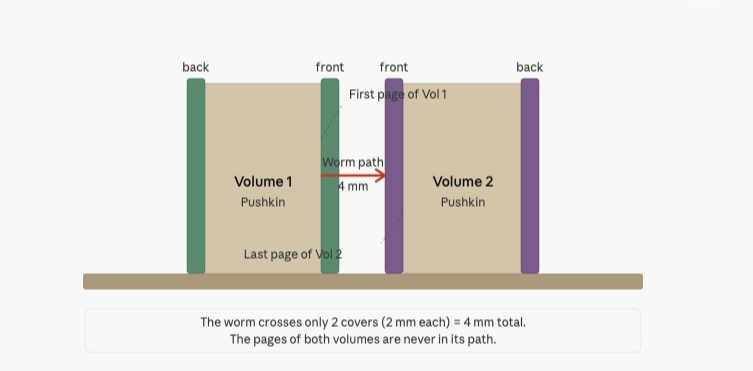
The Question
▶️ Create a new code cell and run it: ( Level2 → part1.ipynb )
hard = """
On a bookshelf, two volumes of Pushkin stand side by side: the first and the second.
The pages of each volume together have a thickness of 2 cm, and each cover is 2 mm thick.
A worm chewed/ate (perpendicular to the pages) from the first page of the first volume to the last page of the second volume.
What distance did it chewed/ate through?
"""
hard_puzzle = [
    {"role": "user", "content": hard}
]
Testing Different Models
▶️ Create a new code cell and run it: ( model: gpt-5-nano , reasoning: minimal )
response = openai.chat.completions.create(model="gpt-5-nano", messages=hard_puzzle, reasoning_effort="minimal")
display(Markdown(response.choices[0].message.content))
✅ Output : 4.4 cm
▶️ Create a new code cell and run it: ( model: claude-sonnet-4 , reasoning: N/A )
response = anthropic.chat.completions.create(model="claude-sonnet-4-6", messages=hard_puzzle)
display(Markdown(response.choices[0].message.content))
✅ Output : 4 mm
▶️ Create a new code cell and run it: ( model: gpt-5 , reasoning: N/A )
response = openai.chat.completions.create(model="gpt-5", messages=hard_puzzle)
display(Markdown(response.choices[0].message.content))
✅ Output : 4 mm
▶️ Create a new code cell and run it: ( model: gemini-2.5-pro , reasoning: N/A )
response = gemini.chat.completions.create(model="gemini-2.5-pro", messages=hard_puzzle)
display(Markdown(response.choices[0].message.content))
✅ Output : 4 mm
✅ Results & Takeaway
The correct answer is 4 mm.
Almost every frontier model got this right — the only exception was GPT-5 Nano, which is expected given its smaller size.
🔍 What This Tells Us
Model Size | Accuracy on Hard Puzzles |
|---|---|
🟢 Large frontier models | Solve these easily today |
🟡 Smaller models | May struggle or get it wrong |
🔴 Older models | Often fail on these types of questions |
💡 Today's leading frontier models have become remarkably capable at complex reasoning tasks. But the moment you step down to an older or smaller model, these cracks start to show — making puzzles like this a great way to benchmark reasoning ability across models.