The Spiral Model is a Risk-Driven process. Instead of following a rigid sequence, the project repeats a set of phases over and over in a "spiral" shape. Each loop around the spiral represents a new version (or prototype) of the software.
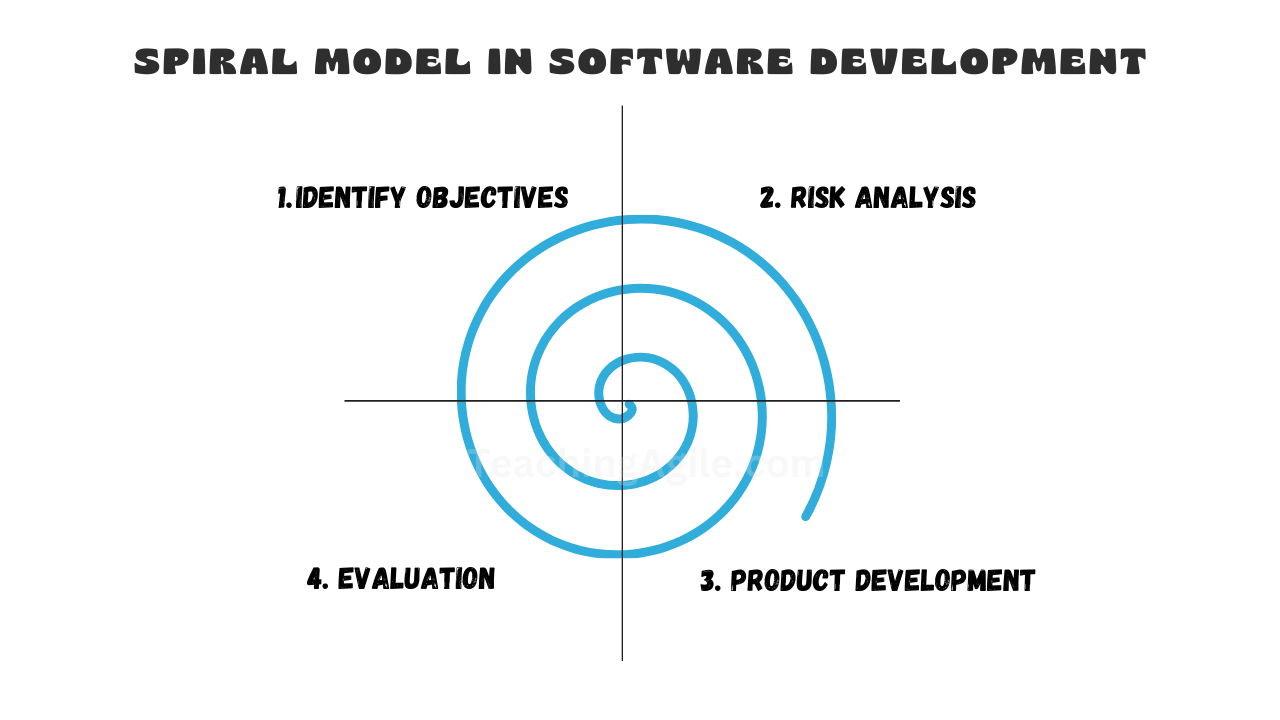
🎡 The Four Quadrants
Every cycle (loop) in the spiral is divided into four main activities:
Objective Setting (Planning):
Identify the objectives of the current phase.
Determine constraints and alternative solutions.
Risk Analysis:
This is the "Heart" of the model.
The team identifies technical and management risks (e.g., "Will the database handle this much traffic?").
Prototyping is often used here to test risky ideas before committing to full development.
Engineering (Development & Testing):
The actual code is written and tested.
In the first few loops, this might just be a mockup. In later loops, it is the production-ready code.
Review & Planning (Evaluation):
The customer evaluates the work.
The team decides whether to continue to the next loop of the spiral.
🛡️ Why is it called "Risk-Driven"?
In Waterfall, you find out if a project is impossible at the end. In the Spiral Model, you find out at the beginning.
If a project has a high chance of failing (e.g., using a brand-new technology that might not work), the Spiral Model forces you to address that risk in the very first loop. If the risk is too high, the project is cancelled before millions of dollars are wasted.
✅ Advantages
Risk Handling: No other model manages uncertainty and risk as well as this one.
Flexibility: Requirements can be added or changed at each loop (at the end of the quadrant).
Customer Satisfaction: The customer gets to see the progress at every loop and provide feedback.
Big Projects: Ideal for massive, complex systems (like space shuttle software or national banking systems).
❌ Disadvantages
Expensive: It requires highly skilled "Risk Assessment" experts.
Time Consuming: The number of loops can be high, leading to long development times.
Not for Small Projects: The overhead of planning and risk analysis is too much for a simple mobile app.
Project Success depends on Risk Analysis: If you fail to identify a major risk during quadrant 2, the model fails.
📊 Comparison: Waterfall vs. Spiral
Feature | Waterfall | Spiral |
|---|---|---|
Approach | Linear / Rigid | Iterative / Flexible |
Risk | High (found at the end) | Low (found at every loop) |
Cost | Low (if no changes) | High (due to experts) |
Best for | Simple, clear projects | Complex, high-risk projects |