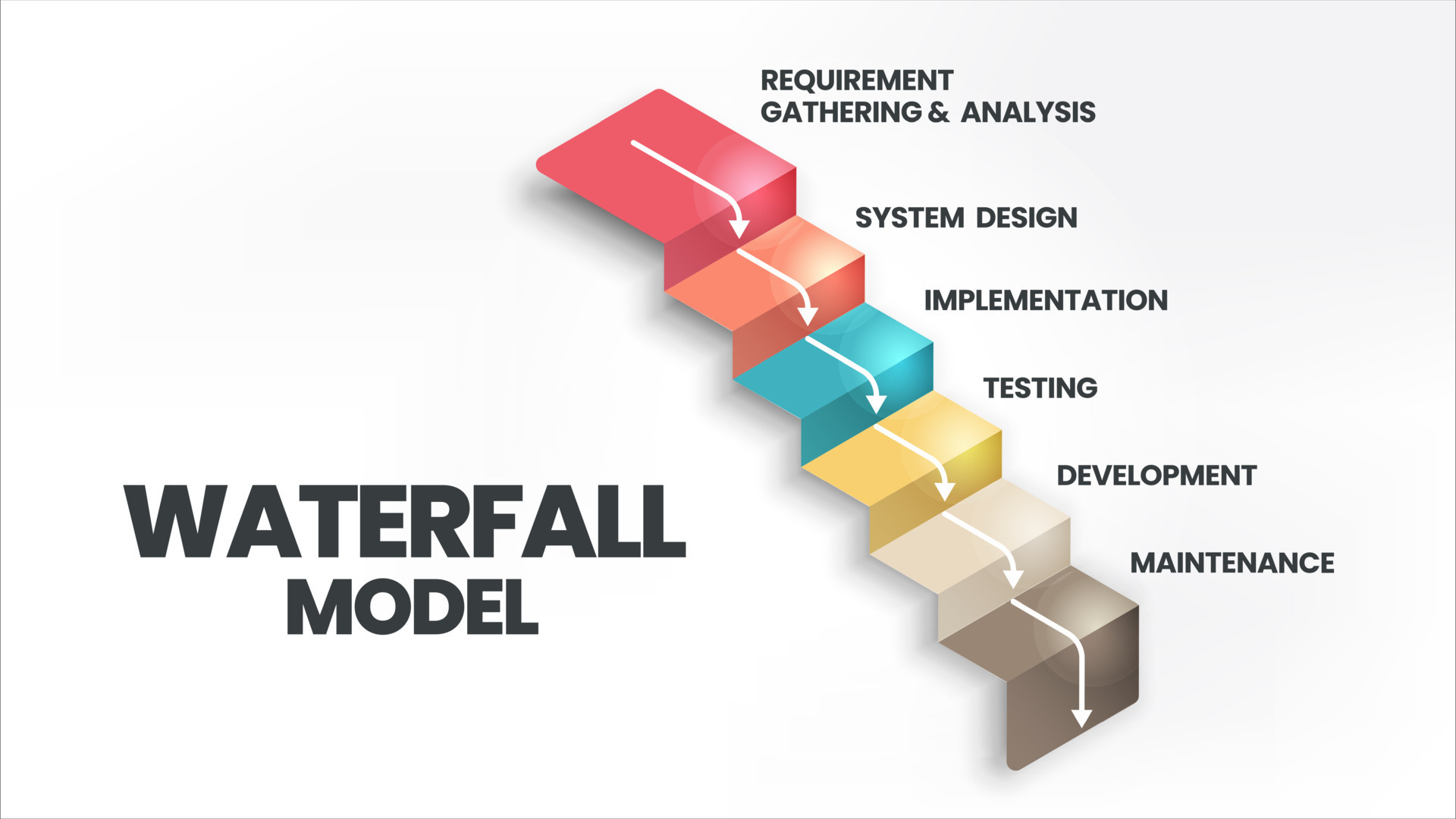
Think of the Waterfall model like a physical staircase: you can only move down to the next step once you’ve finished the one above. There is no "going back" up the stairs once you’ve moved on.
📋 The Sequential Phases
In a classic Waterfall approach, the project moves through these stages in a strict order:
Requirements Analysis: All possible requirements of the system to be developed are captured in this phase and documented in a Requirements Specification document.
System Design: The requirements from the first phase are studied and the system design is prepared. This helps in specifying hardware and system requirements and defining the overall system architecture.
Implementation: With inputs from the system design, the system is first developed in small programs called units, which are integrated in the next phase.
Integration and Testing: All the units developed in the implementation phase are integrated into a system and tested for any faults or failures.
Deployment of System: Once the functional and non-functional testing is done; the product is deployed in the customer environment or released into the market.
Maintenance: There are some issues which come up in the client environment. To fix those issues, patches are released. Also to enhance the product some better versions are released.
✅ When to Use Waterfall?
Despite being considered "old school," Waterfall is still highly effective in specific scenarios:
When the requirements are very well documented, clear, and fixed.
When the product definition is stable.
When the project is short and low risk.
When the technology is understood and is not dynamic.
When there are no ambiguous requirements.
❌ The Disadvantages (Why Agile was born)
The Waterfall model has several significant drawbacks in the modern, fast-paced world:
No Turning Back: High amounts of risk and uncertainty because it is difficult to go back to a previous phase to change something (e.g., if a requirement changes in the middle of coding).
No Working Software until late: You don't see a working version of the software until the very end of the cycle.
High Risk for Long Projects: If the project takes 2 years, by the time you finish, the customer’s needs might have completely changed.
The "Testing Trap": Testing only happens at the end. If a major design flaw is found during testing, it can be catastrophic for the budget and timeline.
📊 Waterfall vs. Modern Reality
Feature | Waterfall Expectation | Real-World Reality |
|---|---|---|
Requirements | Known 100% at the start. | Change constantly. |
Feedback | Only at the very end. | Needed continuously. |
Risk | Managed by planning. | Managed by iterating. |
💡 Waterfall is often compared to Construction Engineering (Building a bridge). You can't change the foundation once the 10th floor is built. Software, however, is usually more like Gardening—it grows and needs constant pruning.