Software Architecture is the set of principal design decisions about a system. It defines the "style" of the house before you start picking out the furniture.
🏠 Common Architectural Styles
Different types of software require different architectures. Here are the most common patterns used in the industry:
1. Layered (N-Tier) Architecture
The most common architecture for business applications. It organizes the system into layers, where each layer has a specific responsibility and only communicates with the layer directly below it.
Presentation Layer: The UI (User Interface).
Business Layer: The logic and rules.
Data Access Layer: How we talk to the database.
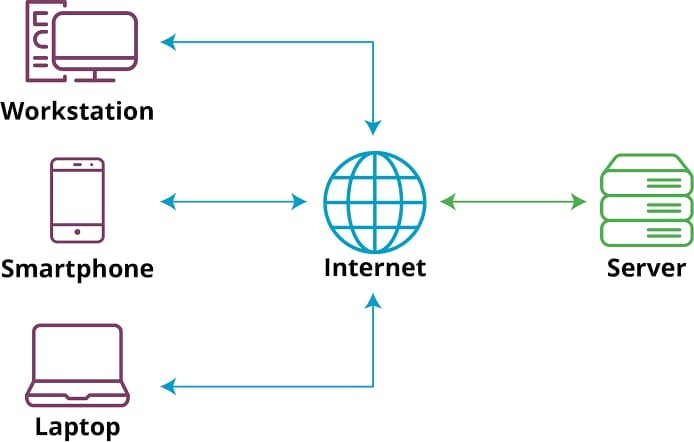
2. Client-Server Architecture
The foundation of the Internet. The system is divided into Clients (who request services) and Servers (who provide them).
Example: Your web browser (Client) requesting a page from Google's servers.
3. Microservices Architecture
Instead of one giant application (a Monolith), the system is broken into small, independent services that communicate over a network.
Pros: Each service can be written in a different language and scaled independently.
Example: Netflix uses thousands of microservices (one for "Recommendations," one for "Billing," one for "Video Streaming").
4. Model-View-Controller (MVC)
A pattern used to separate the representation of information from the user's interaction with it.
Model: Manages the data and logic.
View: Displays the data (The UI).
Controller: Connects the two, handling user input.
🧩 Key Architectural Decisions
When designing the architecture, engineers must consider Non-Functional Requirements (Quality Attributes):
Performance: Should we use a "Pipe-and-Filter" architecture for high-speed data processing?
Security: Should we put the database in a private layer that is inaccessible to the public?
Availability: Do we need redundant servers to ensure the site never goes down?
Maintainability: Is the system modular enough that we can swap out a component easily?
⚖️ Monolith vs. Microservices: The Choice
Feature | Monolithic | Microservices |
|---|---|---|
Complexity | Simple to develop and deploy initially. | Highly complex to manage and coordinate. |
Scaling | Must scale the entire app. | Can scale only the service that is busy. |
Fault Tolerance | If the app crashes, everything goes down. | If one service fails, others keep working. |
Best For | Small teams and new startups. | Large, complex systems with many teams. |
🔍 Why does Architecture matter?
You cannot "fix" a bad architecture with good code. If you build a skyscraper on a foundation meant for a shed, it will eventually collapse.
Enables Communication: Stakeholders can understand the system without looking at code.
Facilitates Reuse: You can reuse architectural patterns across different projects.
Risk Management: It identifies potential bottlenecks (e.g., "The database will be a single point of failure").