🏷️ __name__
__name__ is a special variable that tells Python the name under which a file (module) is being used.
The most important thing to understand is that its value changes depending on how the Python file is run.
▶️ When You Run the File Directly
Suppose we have a file called calculator.py:
print(__name__)If you run:
python calculator.pyPython sets:
__name__ = "__main__"So the output is:
__main__👉 The file being run directly is always called "__main__" by Python.
📦 When You Import the File
Suppose calculator.py contains:
print(__name__)And another file contains:
import calculatorNow calculator.py is not being run directly. It is being imported.
So Python sets:
__name__ = "calculator"Output:
calculator🔑 Why if __name__ == "__main__"?
Consider:
# calculator.py

def add(a, b):
    return a + b

if __name__ == "__main__":
    print(add(10, 5)) #15
If we import calculator.py:
import calculatorNow:
__name__ == "calculator" is Falseprint(add(10, 5)) does NOT run
But we can still use:
print(calculator.add(10, 5))🧠 Think of It Like This
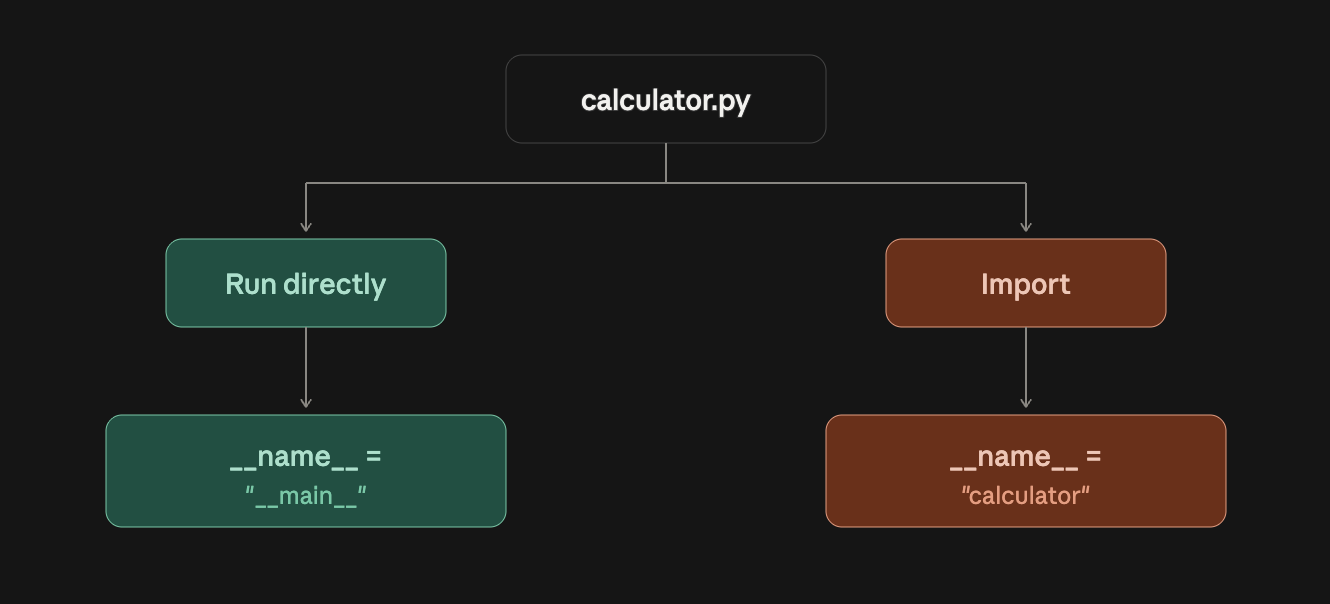
Therefore:
if __name__ == "__main__":means:
"Run this code only if this file is being executed directly, not when it is imported."
⭐ Remember
__name__ → Tells Python how the current file is being used.
"__main__" → The file is being run directly.
<div class="infographic-pyname">
<style>
.infographic-pyname {
--ink: #1a1a1a;
--ink-soft: #5c5c5c;
--paper: #ffffff;
--paper-alt: #f0ece4;
--accent: #2563eb;
--accent-soft:#e3ebfd;
--line: #ddd6c9;
--true-c: #1f9d55; --true-soft: #e3f5ec;
--false-c: #c0392b; --false-soft: #fbe9e7;
--mono-font: 'IBM Plex Mono', 'SFMono-Regular', Menlo, monospace;
--display-font: 'Fraunces', Georgia, serif;
--body-font: 'Inter', system-ui, sans-serif;
box-sizing: border-box;
max-width: 720px;
margin: 0 auto;
font-family: var(--body-font);
color: var(--ink);
background: var(--paper);
}
.infographic-pyname[data-theme="dark"] {
--ink: #e8e6e1;
--ink-soft: #9a968c;
--paper: #121212;
--paper-alt: #1e1e26;
--accent: #5b8def;
--accent-soft:#202942;
--line: #2c313d;
--true-c: #6fdc8c; --true-soft: #1c3324;
--false-c: #e57373; --false-soft: #3a2222;
}
.infographic-pyname *, .infographic-pyname *::before, .infographic-pyname *::after { box-sizing: border-box; }
.infographic-pyname .nm-wrap { padding: 0 clamp(1rem, 4vw, 2rem) 1.5rem; }
.infographic-pyname h1 {
font-family: var(--display-font); font-weight: 600;
font-size: clamp(1.5rem, 5vw, 2.05rem); text-align: center; margin: 1.5rem 0 0.25rem; letter-spacing: -0.01em;
}
.infographic-pyname .nm-sub { text-align: center; color: var(--ink-soft); font-size: 0.86rem; margin: 0 0 1.3rem; }
.infographic-pyname .files-row { display: grid; grid-template-columns: 1fr 1fr; gap: 0.8rem; margin-bottom: 1.2rem; }
@media (max-width: 540px) { .infographic-pyname .files-row { grid-template-columns: 1fr; } }
.infographic-pyname .file-card { border: 1.5px solid var(--line); border-radius: 8px; overflow: hidden; transition: border-color 0.25s, box-shadow 0.25s; }
.infographic-pyname .file-card.is-focus { border-color: var(--accent); box-shadow: 0 0 0 2px var(--accent-soft); }
.infographic-pyname .file-bar {
font-family: var(--mono-font); font-size: 0.75rem; font-weight: 700; color: var(--ink-soft);
background: var(--paper-alt); padding: 0.4rem 0.6rem; border-bottom: 1px solid var(--line);
}
.infographic-pyname .file-body {
font-family: var(--mono-font); font-size: 0.76rem; line-height: 1.65; white-space: pre;
padding: 0.6rem 0.7rem; background: var(--paper); color: var(--ink); min-height: 5.5em;
}
.infographic-pyname .file-body .kw { color: var(--accent); font-weight: 700; }
.infographic-pyname .file-body .hl { background: var(--accent-soft); border-radius: 3px; }
.infographic-pyname .mode-row { display: flex; justify-content: center; gap: 0.5rem; margin-bottom: 1rem; flex-wrap: wrap; }
.infographic-pyname .mode-btn {
font: inherit; font-family: var(--mono-font); font-size: 0.8rem; font-weight: 700;
background: var(--paper-alt); border: 1.5px solid var(--line); color: var(--ink-soft);
padding: 0.45rem 0.75rem; cursor: pointer; border-radius: 6px;
}
.infographic-pyname .mode-btn.is-selected { border-color: var(--accent); color: var(--accent); background: var(--accent-soft); }
.infographic-pyname .run-row { display: flex; justify-content: center; margin-bottom: 1rem; }
.infographic-pyname .run-btn {
font: inherit; font-family: var(--mono-font); font-size: 0.85rem; font-weight: 700;
background: var(--accent); color: #fff; border: none; border-radius: 999px;
padding: 0.55rem 1.2rem; cursor: pointer;
}
.infographic-pyname .run-btn:disabled { opacity: 0.5; cursor: default; }
.infographic-pyname .name-badge-row { display: flex; justify-content: center; gap: 0.6rem; margin-bottom: 1rem; flex-wrap: wrap; }
.infographic-pyname .status-card { background: var(--paper-alt); border: 1px solid var(--line); border-radius: 6px; padding: 0.5rem 0.8rem; text-align: center; font-family: var(--mono-font); font-size: 0.82rem; }
.infographic-pyname .status-card .badge { font-weight: 700; padding: 0.08rem 0.45rem; border-radius: 999px; margin-left: 0.3rem; }
.infographic-pyname .status-card .badge.t { background: var(--true-soft); color: var(--true-c); }
.infographic-pyname .status-card .badge.f { background: var(--false-soft); color: var(--false-c); }
.infographic-pyname .device {
--ed-bg: #1e1e1e; --ed-bar: #2d2d2d; --ed-text: #d4d4d4; --ed-soft: #8a8a8a; --ed-ok: #6fdc8c;
background: var(--ed-bg); border: 1px solid var(--line); border-radius: 8px; overflow: hidden;
}
.infographic-pyname .device-bar {
display: flex; align-items: center; gap: 0.4rem;
background: var(--ed-bar); padding: 0.5rem 0.7rem; border-bottom: 1px solid #3a3a3a;
font-size: 0.72rem; color: var(--ed-soft); font-weight: 600;
}
.infographic-pyname .device-bar .dot { width: 9px; height: 9px; border-radius: 50%; background: #5a5a5a; }
.infographic-pyname .device-bar .dot:nth-child(1) { background: #ff5f56; }
.infographic-pyname .device-body { padding: 0.75rem 0.9rem; font-family: var(--mono-font); font-size: 0.8rem; color: var(--ed-text); min-height: 90px; }
.infographic-pyname .log-line { display: flex; gap: 0.5rem; line-height: 1.75; opacity: 0; animation: nm-fadein 0.25s ease forwards; flex-wrap: wrap; }
@keyframes nm-fadein { from { opacity: 0; transform: translateY(3px); } to { opacity: 1; transform: translateY(0); } }
.infographic-pyname .log-line .out { color: #fff; }
.infographic-pyname .log-line .fin { color: var(--ed-ok); font-weight: 700; }
.infographic-pyname .log-empty { color: var(--ed-soft); }
.infographic-pyname .nm-caption { text-align: center; font-size: 0.85rem; color: var(--ink-soft); margin-top: 0.9rem; }
@media (prefers-reduced-motion: reduce) {
.infographic-pyname *, .infographic-pyname *::before, .infographic-pyname *::after {
animation-duration: 0.001ms !important; transition-duration: 0.001ms !important;
}
}
</style>
<div class="nm-wrap">
<h1>__name__</h1>
<p class="nm-sub">Same file, same code — but __name__ changes depending on how it's launched.</p>
<div class="files-row">
<div class="file-card" id="cardCalc">
<div class="file-bar">calculator.py</div>
<div class="file-body"><span class="kw">def</span> add(a, b):
<span class="kw">return</span> a + b
<span class="kw">if</span> <span class="hl" id="hlIf">__name__ == "__main__"</span>:
print(add(10, 5))</div>
</div>
<div class="file-card" id="cardApp">
<div class="file-bar">app.py</div>
<div class="file-body"><span class="kw">import</span> calculator
print(calculator.add(10, 5))</div>
</div>
</div>
<div class="mode-row">
<button class="mode-btn is-selected" data-mode="direct">python calculator.py</button>
<button class="mode-btn" data-mode="import">python app.py</button>
</div>
<div class="run-row"><button class="run-btn" id="runBtn">Run</button></div>
<div class="name-badge-row">
<div class="status-card">calculator.py __name__ = <span class="badge t" id="nameBadge">"__main__"</span></div>
<div class="status-card">if block runs? <span class="badge t" id="ifBadge">Yes</span></div>
</div>
<div class="device">
<div class="device-bar"><span class="dot"></span><span class="dot"></span><span class="dot"></span> Terminal</div>
<div class="device-body" id="nmLog"><div class="log-empty">Pick how it's run, then hit Run.</div></div>
</div>
<p class="nm-caption" id="nmCaption">Run the file directly and __name__ becomes "__main__" — the if block fires.</p>
</div>
<script>
(function () {
var root = document.currentScript.closest('.infographic-pyname')
|| document.querySelector('.infographic-pyname');
var bodyAttr = document.body.getAttribute('data-darkmode');
var dark;
if (bodyAttr === 'true') { dark = true; }
else if (bodyAttr === 'false') { dark = false; }
else {
var match = document.cookie.match(/(?:^|;\s*)darkMode=([^;]+)/);
dark = match ? match[1] === 'true' : false;
}
if (dark) root.setAttribute('data-theme', 'dark');
var modeBtns = root.querySelectorAll('.mode-btn');
var runBtn = root.querySelector('#runBtn');
var nameBadge = root.querySelector('#nameBadge');
var ifBadge = root.querySelector('#ifBadge');
var nmLog = root.querySelector('#nmLog');
var nmCaption = root.querySelector('#nmCaption');
var cardCalc = root.querySelector('#cardCalc');
var cardApp = root.querySelector('#cardApp');
var currentMode = 'direct';
var firstLog = true;
var captions = {
direct: 'Run the file directly and __name__ becomes "__main__" — the if block fires.',
import: 'Import the file instead and __name__ becomes "calculator" — the if block is skipped.'
};
modeBtns.forEach(function (btn) {
btn.addEventListener('click', function () {
modeBtns.forEach(function (b) { b.classList.toggle('is-selected', b === btn); });
currentMode = btn.dataset.mode;
nmCaption.textContent = captions[currentMode];
});
});
function logLine(text, cls) {
if (firstLog) { nmLog.innerHTML = ''; firstLog = false; }
var line = document.createElement('div');
line.className = 'log-line';
line.innerHTML = '<span class="' + (cls || 'out') + '">' + text + '</span>';
nmLog.appendChild(line);
nmLog.scrollTop = nmLog.scrollHeight;
}
function setBadge(el, text, isTrue) {
el.textContent = text;
el.className = 'badge ' + (isTrue ? 't' : 'f');
}
runBtn.addEventListener('click', function () {
runBtn.disabled = true;
firstLog = true;
nmLog.innerHTML = '';
cardCalc.classList.remove('is-focus');
cardApp.classList.remove('is-focus');
var steps = [];
if (currentMode === 'direct') {
steps.push(function () {
cardCalc.classList.add('is-focus');
logLine('$ python calculator.py');
});
steps.push(function () {
logLine('calculator.py runs top to bottom — Python sets __name__ = "__main__"');
setBadge(nameBadge, '"__main__"', true);
});
steps.push(function () {
logLine('if __name__ == "__main__": → True', 'fin');
setBadge(ifBadge, 'Yes', true);
});
steps.push(function () {
logLine('15');
});
} else {
steps.push(function () {
cardApp.classList.add('is-focus');
logLine('$ python app.py');
});
steps.push(function () {
logLine('app.py hits "import calculator" — calculator.py runs top to bottom too');
});
steps.push(function () {
cardCalc.classList.add('is-focus');
cardApp.classList.remove('is-focus');
logLine('calculator.py is being imported — Python sets __name__ = "calculator"');
setBadge(nameBadge, '"calculator"', false);
});
steps.push(function () {
logLine('if __name__ == "__main__": → False, skipped', 'fin');
setBadge(ifBadge, 'No', false);
});
steps.push(function () {
cardApp.classList.add('is-focus');
logLine('app.py explicitly calls calculator.add(10, 5)');
});
steps.push(function () {
logLine('15');
});
}
var i = 0;
function next() {
if (i < steps.length) {
steps[i]();
i++;
setTimeout(next, 550);
} else {
runBtn.disabled = false;
}
}
next();
});
})();
</script>
</div>