🔒 Closures
A closure is a function that remembers and can access variables from its enclosing function, even after the enclosing function has finished executing.
🔹 Basic Example
def outer():
    message = "Hello"

    def inner():
        print(message)

    return inner

greet = outer()
greet() #Hello
How it works:
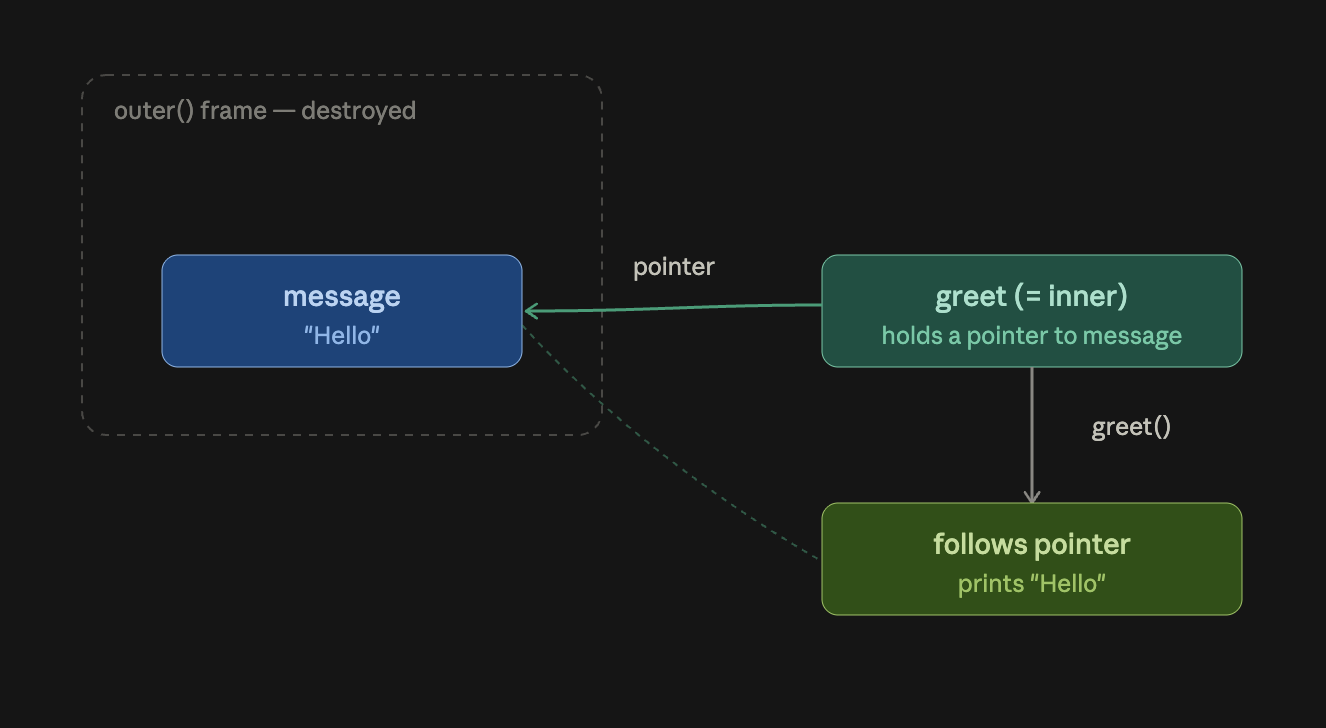
The inner() function is a closure because it remembers the variable message from outer().
🔹 Closure with a Parameter
def multiplier(x):

    def multiply(y):
        return x * y

    return multiply

double = multiplier(2)
triple = multiplier(3)

print(double(5)) #10
print(triple(5)) #15
Here:
double → remembers x = 2
triple → remembers x = 3
Even though multiplier() has finished executing, the returned functions remember their respective values of x.
🔒 Example Counter
A closure is an inner function that remembers variables from its outer function even after the outer function finishes.
def make_counter():
    count = 0

    def counter():
        nonlocal count
        count += 1
        return count

    return counter
🔄 How it works
counter = make_counter()countstarts at0make_counter()returnscountercounter()rememberscount
print(counter())  # 1
print(counter())  # 2
print(counter())  # 3
count keeps its value between calls because of the closure.
🔑 nonlocal
nonlocal countmeans:
"Use and modify the
countfrom the outer function."
Closure = Inner function + remembered outer variable 🔒
<div class="infographic-pyclosure">
  <style>
    .infographic-pyclosure {
      --ink:        #1a1a1a;
      --ink-soft:   #5c5c5c;
      --paper:      #ffffff;
      --paper-alt:  #f0ece4;
      --accent:     #2563eb;
      --accent-soft:#e3ebfd;
      --line:       #ddd6c9;
      --mono-font: 'IBM Plex Mono', 'SFMono-Regular', Menlo, monospace;
      --display-font: 'Fraunces', Georgia, serif;
      --body-font: 'Inter', system-ui, sans-serif;
      box-sizing: border-box;
      max-width: 680px;
      margin: 0 auto;
      font-family: var(--body-font);
      color: var(--ink);
      background: var(--paper);
    }
    .infographic-pyclosure[data-theme="dark"] {
      --ink:        #e8e6e1;
      --ink-soft:   #9a968c;
      --paper:      #121212;
      --paper-alt:  #1e1e26;
      --accent:     #5b8def;
      --accent-soft:#202942;
      --line:       #2c313d;
    }
    .infographic-pyclosure *, .infographic-pyclosure *::before, .infographic-pyclosure *::after { box-sizing: border-box; }
    .infographic-pyclosure .cl-wrap { padding: 0 clamp(1rem, 4vw, 2rem) 1.5rem; }
    .infographic-pyclosure h1 {
      font-family: var(--display-font); font-weight: 600;
      font-size: clamp(1.5rem, 5vw, 2.05rem); text-align: center; margin: 1.5rem 0 0.25rem; letter-spacing: -0.01em;
    }
    .infographic-pyclosure .cl-sub { text-align: center; color: var(--ink-soft); font-size: 0.86rem; margin: 0 0 1.4rem; }

    .infographic-pyclosure .code-block {
      font-family: var(--mono-font); font-size: 0.82rem; line-height: 1.7; white-space: pre;
      background: var(--paper-alt); border: 1px solid var(--line); border-radius: 8px;
      padding: 0.85rem 1rem; margin-bottom: 1.2rem;
    }
    .infographic-pyclosure .code-block .kw { color: var(--accent); font-weight: 700; }
    .infographic-pyclosure .code-block .comment { color: var(--ink-soft); }

    .infographic-pyclosure .ctl-row { display: flex; justify-content: center; gap: 0.6rem; margin-bottom: 1.3rem; flex-wrap: wrap; }
    .infographic-pyclosure .add-btn {
      font: inherit; font-family: var(--mono-font); font-size: 0.85rem; font-weight: 700;
      background: var(--accent); color: #fff; border: none; border-radius: 999px;
      padding: 0.55rem 1.2rem; cursor: pointer;
    }
    .infographic-pyclosure .add-btn:disabled { opacity: 0.5; cursor: default; }
    .infographic-pyclosure .clear-btn {
      font: inherit; font-size: 0.78rem; font-weight: 600; color: var(--ink-soft);
      background: none; border: 1px solid var(--line); padding: 0.4rem 0.8rem; cursor: pointer; border-radius: 999px;
    }

    .infographic-pyclosure .counter-grid { display: flex; flex-wrap: wrap; justify-content: center; gap: 0.8rem; margin-bottom: 1rem; }
    .infographic-pyclosure .counter-card {
      border: 2px solid var(--accent); background: var(--accent-soft); border-radius: 10px;
      padding: 0.9rem 1rem; display: flex; flex-direction: column; align-items: center; gap: 0.5rem;
      min-width: 140px; animation: cl-pop-in 0.3s ease;
    }
    @keyframes cl-pop-in { from { opacity: 0; transform: scale(0.8); } to { opacity: 1; transform: scale(1); } }
    .infographic-pyclosure .counter-name { font-family: var(--mono-font); font-size: 0.78rem; font-weight: 700; color: var(--accent); }
    .infographic-pyclosure .counter-value {
      font-family: var(--display-font); font-size: 2.2rem; font-weight: 600; color: var(--ink); line-height: 1;
      transition: transform 0.15s;
    }
    .infographic-pyclosure .counter-value.is-pulsing { animation: cl-bump 0.3s ease; }
    @keyframes cl-bump { 0% { transform: scale(1); } 45% { transform: scale(1.25); } 100% { transform: scale(1); } }
    .infographic-pyclosure .counter-call-btn {
      font: inherit; font-family: var(--mono-font); font-size: 0.78rem; font-weight: 700;
      background: var(--paper); color: var(--accent); border: 1.5px solid var(--accent); border-radius: 6px;
      padding: 0.35rem 0.7rem; cursor: pointer;
    }

    .infographic-pyclosure .cl-caption {
      text-align: center; font-size: 0.85rem; color: var(--ink-soft); min-height: 2.4em;
    }
    .infographic-pyclosure .cl-caption strong { color: var(--ink); font-family: var(--mono-font); }

    @media (prefers-reduced-motion: reduce) {
      .infographic-pyclosure *, .infographic-pyclosure *::before, .infographic-pyclosure *::after {
        animation-duration: 0.001ms !important; transition-duration: 0.001ms !important;
      }
    }
  </style>

  <div class="cl-wrap">
    <p class="cl-sub">A function that remembers the variables around it, even after that scope is gone.</p>

    <div class="code-block"><span class="kw">def</span> make_counter():
    count = 0
    <span class="kw">def</span> counter():
        <span class="kw">nonlocal</span> count
        count += 1
        <span class="kw">return</span> count
    <span class="kw">return</span> counter  <span class="comment"># count lives on inside it</span></div>

    <div class="ctl-row">
      <button class="add-btn" id="addBtn">Run: counter_1 = make_counter()</button>
      <button class="clear-btn" id="clearBtn">↺ Clear all</button>
    </div>

    <div class="counter-grid" id="counterGrid"></div>

    <p class="cl-caption" id="clCaption">Each call to make_counter() creates a brand-new count — sealed inside its own counter().</p>
  </div>

  <script>
    (function () {
      var root = document.currentScript.closest('.infographic-pyclosure')
        || document.querySelector('.infographic-pyclosure');

      var bodyAttr = document.body.getAttribute('data-darkmode');
      var dark;
      if (bodyAttr === 'true') { dark = true; }
      else if (bodyAttr === 'false') { dark = false; }
      else {
        var match = document.cookie.match(/(?:^|;\s*)darkMode=([^;]+)/);
        dark = match ? match[1] === 'true' : false;
      }
      if (dark) root.setAttribute('data-theme', 'dark');

      var addBtn = root.querySelector('#addBtn');
      var clearBtn = root.querySelector('#clearBtn');
      var counterGrid = root.querySelector('#counterGrid');
      var clCaption = root.querySelector('#clCaption');
      var MAX_COUNTERS = 4;
      var counters = []; // { id, name, count, valueEl, cardEl }

      function updateAddBtn() {
        var nextIdx = counters.length + 1;
        addBtn.textContent = 'Run: counter_' + nextIdx + ' = make_counter()';
        addBtn.disabled = counters.length >= MAX_COUNTERS;
      }

      function updateCaption() {
        if (counters.length === 0) {
          clCaption.innerHTML = 'Each call to make_counter() creates a brand-new count — sealed inside its own counter().';
        } else if (counters.length === 1) {
          clCaption.innerHTML = 'Tap "call ' + counters[0].name + '()" a few times — it remembers its own count between calls.';
        } else {
          var parts = counters.map(function (c) { return '<strong>' + c.name + '</strong> = ' + c.count; }).join(', ');
          clCaption.innerHTML = parts + ' — every counter has its own private count. Calling one never touches the others.';
        }
      }

      function addCounter() {
        if (counters.length >= MAX_COUNTERS) return;
        var idx = counters.length + 1;
        var name = 'counter_' + idx;

        var card = document.createElement('div');
        card.className = 'counter-card';
        card.innerHTML =
          '<div class="counter-name">' + name + '()</div>' +
          '<div class="counter-value">0</div>' +
          '<button class="counter-call-btn">call ' + name + '()</button>';
        counterGrid.appendChild(card);

        var valueEl = card.querySelector('.counter-value');
        var btnEl = card.querySelector('.counter-call-btn');
        var state = { id: idx, name: name, count: 0, valueEl: valueEl };
        counters.push(state);

        btnEl.addEventListener('click', function () {
          state.count++;
          valueEl.textContent = state.count;
          valueEl.classList.remove('is-pulsing');
          void valueEl.offsetWidth;
          valueEl.classList.add('is-pulsing');
          updateCaption();
        });

        updateAddBtn();
        updateCaption();
      }

      addBtn.addEventListener('click', addCounter);
      clearBtn.addEventListener('click', function () {
        counters = [];
        counterGrid.innerHTML = '';
        updateAddBtn();
        updateCaption();
      });

      addCounter();
    })();
  </script>
</div>
⭐ Why Use Closures?
Closures are useful for:
🔐 Data hiding
⚙️ Creating customized functions
🎨 Decorators
🧩 Maintaining state between function calls
⭐ Remember
Closure = A function + the variables it remembers from its enclosing scope.
def outer(x):
    def inner():
        return x
    return inner
Here, inner() remembers x even after outer() has finished.