A thread in Java goes through various states from creation to termination. These stages form the Thread Lifecycle.
🚦 Lifecycle States of a Thread:
New
Runnable
Running
Blocked/Waiting
Terminated (Dead)
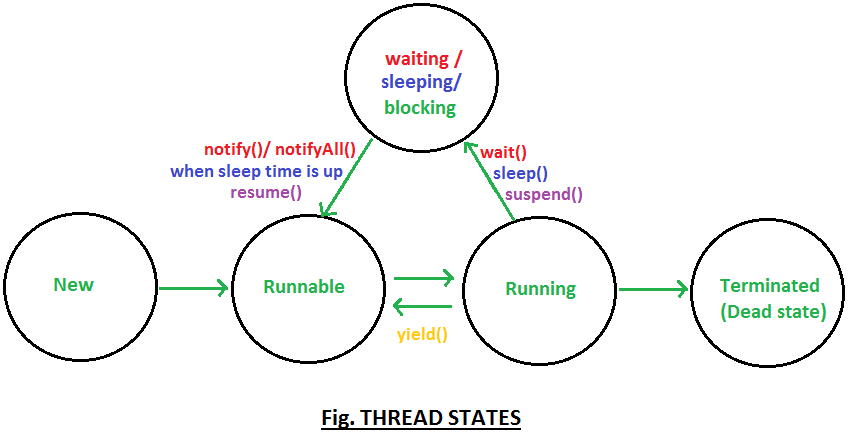
1️⃣ New
The thread is created but not started yet.
Happens when you create a thread object using
new.
🧾 Example:
Thread t = new Thread(); // NEW state2️⃣ Runnable
The thread is ready to run, but it’s waiting for the CPU.
Happens after calling
.start().
🧾 Example:
t.start(); // Now in RUNNABLE state3️⃣ Running
The thread is actively executing the
run()method.It moves from Runnable → Running when the CPU selects it.
🧠 Note:
You cannot control when it moves to running — the CPU scheduler decides.
4️⃣ Blocked / Waiting / Timed Waiting
A thread moves to waiting states when:
It’s waiting for another thread or resource.
It’s paused for a specific time.
🔸 Blocked:
Waiting to acquire a lock held by another thread.
🔸 Waiting:
Waiting indefinitely until notified.
🔸 Timed Waiting:
Waiting for a fixed time (e.g., using sleep() or join(timeout))
🧾 Example:
Thread.sleep(2000); // Moves to TIMED_WAITING state5️⃣ Terminated (Dead)
The thread has finished executing or was forcefully stopped.
Once dead, it cannot be restarted.
🧾 Example:
public void run() {
    System.out.println("Thread ended.");
}
🧠 Summary Table
State | Description |
|---|---|
New | Thread object created |
Runnable |
|
Running | CPU selected the thread |
Blocked / Waiting | Temporarily not running |
Terminated | Thread has finished or stopped |