📚 Introduction to Collections in Java
In Java, a Collection is a framework that provides an architecture to store and manipulate a group of objects. It is part of the java.util package and includes interfaces, classes, and algorithms to perform various data structure operations efficiently.
🧩 Why Use Collections?
Arrays in Java have fixed size and are limited in functionality.
Collections provide dynamic resizing.
They come with built-in methods for searching, sorting, insertion, deletion, etc.
Collections help in writing clean, efficient, and reusable code.
🏗️ The Collection Hierarchy
The Collection Framework includes:
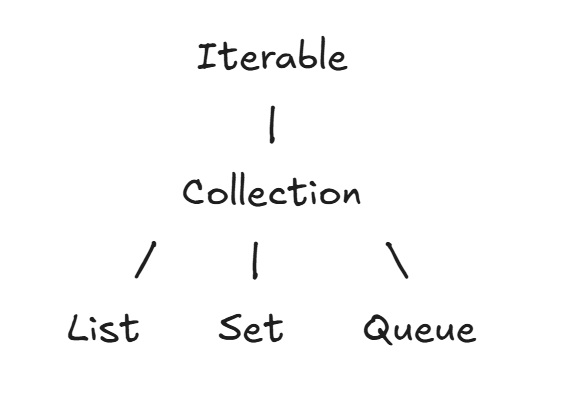
Each interface has different characteristics:
Interface | Description | Examples |
|---|---|---|
List | Ordered collection, allows duplicates | ArrayList, LinkedList |
Set | Unordered, no duplicates | HashSet, TreeSet |
Queue | Ordered in a specific manner (FIFO, LIFO) | PriorityQueue, Deque |
Map (not under Collection) | Stores key-value pairs | HashMap, TreeMap |
🛠️ Common Collection Classes
Class | Description |
|---|---|
ArrayList | Resizable array, fast access |
LinkedList | Doubly-linked list, good for insertions/deletions |
HashSet | Unordered set, no duplicates |
TreeSet | Sorted set |
HashMap | Key-value mapping, allows one null key |
TreeMap | Sorted key-value pairs |
⚙️ Basic Operations
All collections support common methods such as:
add()     // Adds an element
remove()  // Removes an element
size()    // Returns the number of elements
contains() // Checks for presence
clear()   // Removes all elements
🧠 Key Points
Collections work only with objects, not primitives.
Java 5 introduced generics to make collections type-safe (e.g.,
ArrayList<String>).Collections can be iterated using loops or iterators.