❓What is FastAPI?
FastAPI is a modern, high-performance Python web framework is designed for building secure, scalable, and standards-compliant APIs efficiently.
As a web framework, FastAPI provides a ready-made backend structure that handles:
HTTP communication
Data validation
Security
Error handling
Allowing developers to focus on business logic instead of low-level implementation details.
Without a web framework:
You must handle HTTP requests manually
Parse URLs
Read forms or JSON data
Handle errors
Manage security
Return correct HTTP responses
👀 What FastAPI is used for
FastAPI is mainly used to build:
REST APIs
Backend services for web & mobile apps
Microservices
Machine learning model APIs
High-performance backend systems
❗️Why FastAPI stands out
High Performance – One of the fastest web frameworks available.
Rapid Development – Minimal code required to build production-ready APIs
Lightweight & Easy Setup – Applications can be deployed within minutes
Built-in Security – Supports OAuth2, JWT, and modern authentication mechanisms
✅ Key Notes
Low Defect Rate – Strong typing and automatic validation reduce bugs
Easy to Learn – Clean syntax and Python type hints speed up onboarding
Robust & Reliable – Designed for real-world, high-traffic production systems
Standards-Compliant – Uses Open API and JSON Schema for consistent API contracts and automatic documentation
🌐 How FastAPI fits into an application
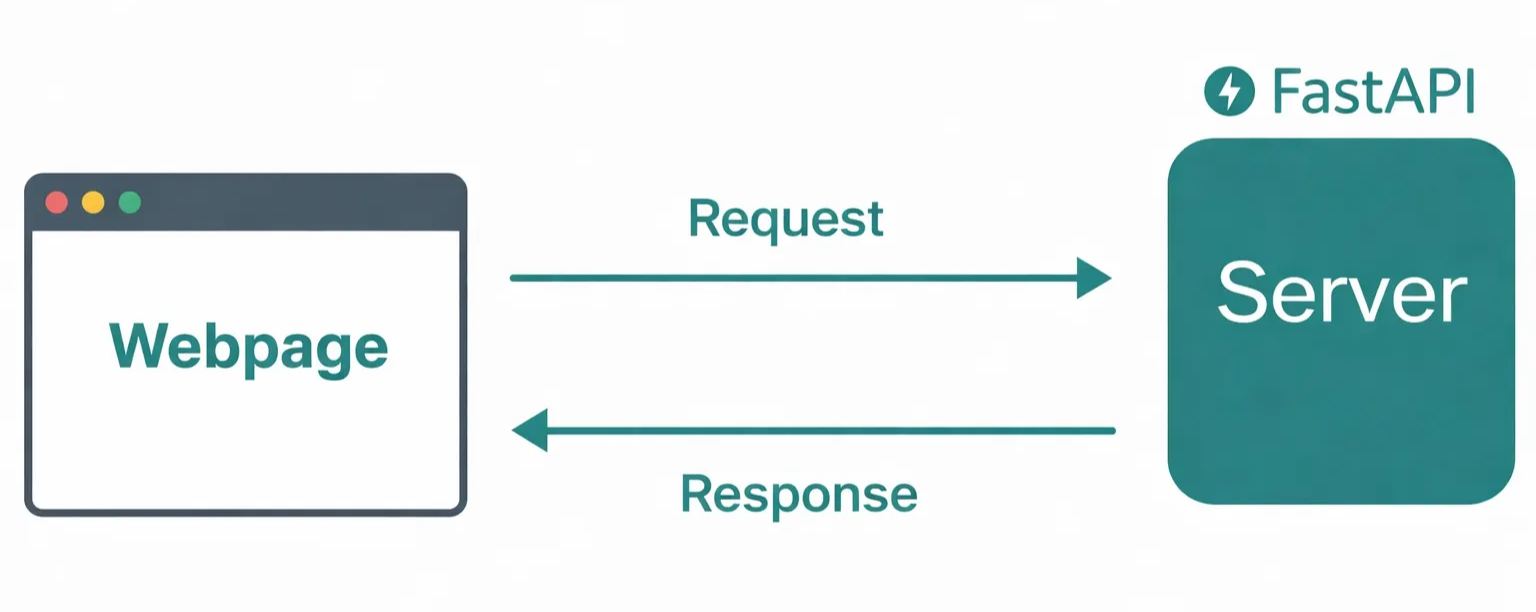
The webpage is what the user interacts with.
The server is your FastAPI application that handles all the logic.
For the webpage to communicate with the server, it uses RESTful APIs.
RESTful APIs – Enable secure communication between client and server
FastAPI ensures that users get correct, secure data and can also leverage additional tools to create full-stack applications where FastAPI handles the backend and frontend.
📱Frontend (Web/Mobile App) - User-facing interface
🖥️FastAPI Server - Handles logic, security, and data processing 🔁
🏢 Real-World Applications
1. Web & Mobile Application Backends
FastAPI is used to power backend services that communicate with web and mobile applications.
Examples:
Netflix – Backend microservices handling user data, recommendations, and content metadata (API-driven architecture)
Uber – Internal backend services and APIs for mobile and web apps
Spotify – API-based services for app communication
2. REST APIs & Microservices
FastAPI is ideal for building microservices due to its speed and low overhead.
Examples:
Microsoft – Teams use FastAPI for internal microservices and cloud-based APIs
Amazon – API-driven microservice architectures (FastAPI commonly used alongside AWS)
Stripe – High-performance API services
3. Machine Learning & AI Model Serving
FastAPI is one of the most popular frameworks for deploying ML models.
Examples:
Microsoft – AI and ML services exposed via FastAPI
OpenAI ecosystem developers – Model-serving APIs
Uber – Machine learning prediction services
4. Real-Time Applications
FastAPI supports Web Sockets for real-time communication.
Examples:
Slack-like systems – Real-time messaging backends
Trading platforms – Live price updates
Gaming services – Real-time player interactions
5. Authentication & Identity Services
FastAPI is frequently used for centralized authentication systems.
Examples:
Google-style identity services (internal APIs)
Enterprise authentication platforms
SaaS applications
6. Data Processing & Automation APIs
FastAPI exposes APIs for processing data and running background tasks.
Examples:
Netflix – Content analytics and processing pipelines
Amazon – Data ingestion services
Fintech platforms – Transaction processing APIs
7. Enterprise & Internal Tools
FastAPI is widely adopted for internal enterprise systems.
Examples:
Microsoft – Internal tooling and APIs
Large enterprises – HR, finance, and analytics systems
8. IoT & Device Communication
FastAPI is used to receive and process data from connected devices.
Examples:
Smart home platforms
Industrial IoT systems
Automotive telemetry service
📌 Summary
FastAPI is a powerful choice for building modern, fast, and secure backend systems, trusted across industries from streaming and fintech to AI and enterprise software.