🗄️ Enhancing the Database — Introducing the Users Table
In this lesson, we are upgrading our database architecture.
Up to this point, we only had a Todos table inside a database named:
todos.dbHowever, this naming is confusing because:
We have a database called
todosInside it, we also have a table called
todos
That lacks clarity and does not scale well.
So we are going to rename the database.
📝 Step 1 — Rename the Database
Inside database.py, where we configured SQLite, update the database name:
todos.db  →  todosapp.db

SQLALCHEMY_DATABASE_URL = "sqlite:///./todos.db"

SQLALCHEMY_DATABASE_URL = "sqlite:///./todosapp.db" 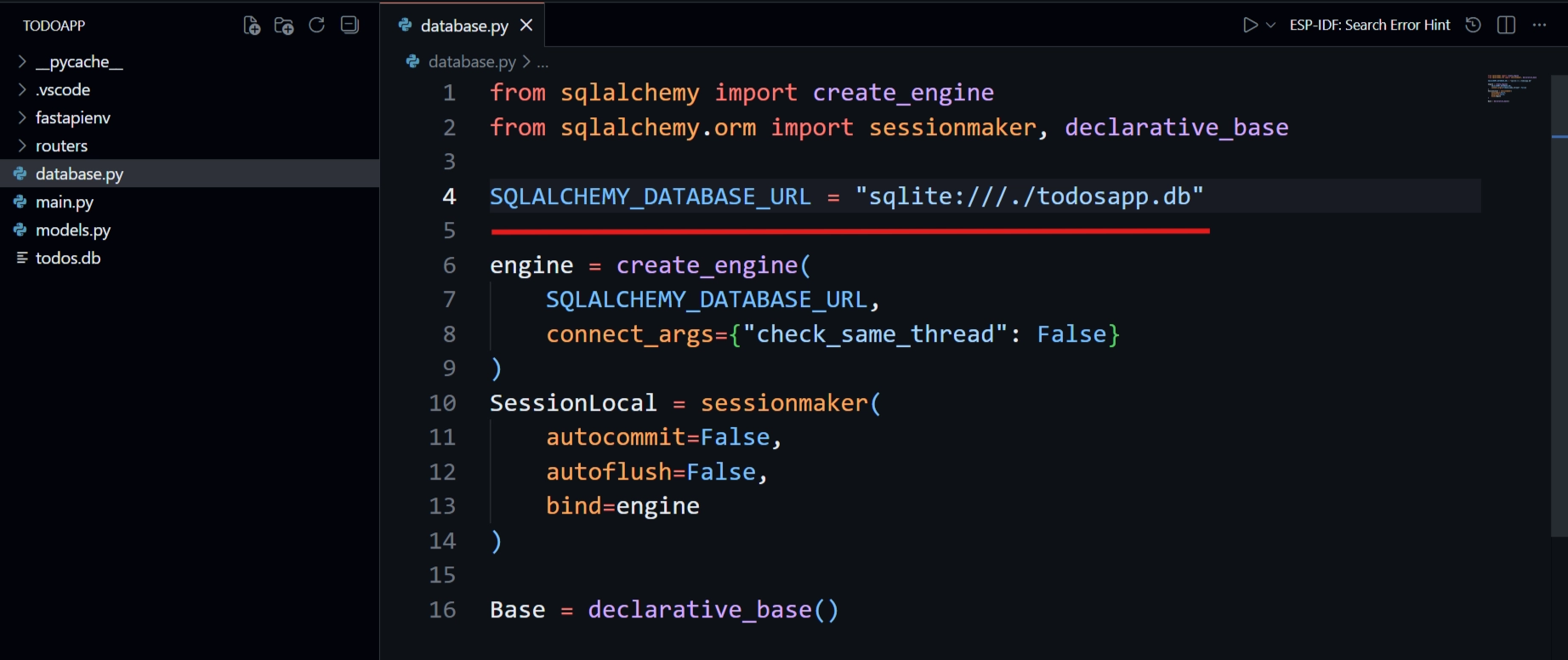
This makes the database represent the entire application, not just one table.
Now our database will contain:
userstabletodostable
This is much cleaner and more scalable.
⚠️ Important Concept — SQLAlchemy Cannot Modify Tables
SQLAlchemy can:
✔ Create tables
❌ Can not Modify existing tables
If we want to enhance or alter existing tables properly in production, we use Alembic (database migrations).
We will cover Alembic later in this course.
🏗️ Step 2 — Update models.py
Before recreating the database, we must define our new structure.
We will:
Add a new
UserstableEnhance the
TodostableAdd a Foreign Key relationship
👤 Creating the Users Table
🗂️ models.py
from database import Base
from sqlalchemy import Column, Integer, String, Boolean

class Users(Base):
    __tablename__ = 'users'

    id = Column(Integer, primary_key=True, index=True)
    email = Column(String, unique=True)
    username = Column(String, unique=True)
    first_name = Column(String)
    last_name = Column(String)
    hashed_password = Column(String)
    is_active = Column(Boolean, default=True)
    role = Column(String)
🔐 Understanding Hashed Passwords (Critical Backend Concept)
We never store plain-text passwords.
Instead:
User enters a password
We hash it
We store only the hash
Hashing is one-way and cannot be reversed.
During login:
Hash the entered password
Compare it with the stored hash
If they match → login succeeds
✔ Developers can’t see passwords
✔ Leaked databases don’t expose passwords
✔ We compare hashes, not plain text
📝 Step 3 — Enhance the Todos Table
Now we update our existing Todos model.
🗂️ models.py
from sqlalchemy import Column, Integer, String, Boolean, ForeignKey

class Todos(Base):
    __tablename__ = 'todos'

    id = Column(Integer, primary_key=True, index=True)
    title = Column(String)
    description = Column(String)
    priority = Column(Integer)
    complete = Column(Boolean, default=False)
    owner_id = Column(Integer, ForeignKey("users.id"))
🔑 What owner_id Means
owner_id = Column(Integer, ForeignKey("users.id"))This means:
Every todo must reference a user.
owner_idstores the primary key of the user.This creates a one-to-many relationship.
One user → Many todos
One todo → One user
Now when a user logs in:
We extract their
id.We fetch all todos where:
owner_id == user.id
That is how we securely isolate user data.
🚀 Step 4 — Recreate the Database
Now:
Run the application
terminal
Delete the old database todos.db and todosapp.db
del todos.db
del todosapp.db
uvicorn main:app --reload
reload the browser
uvicorn main:app --reloaduvicorn main:app --reloadOn startup:
SQLAlchemy reads the models.
Creates
todosapp.db.Creates both
usersandtodostables.Applies the foreign key relationship.
⚠️ Important Reminder
Since we deleted the old database:
All previous todos are gone.
We will recreate data from scratch.
This is expected and correct.
We changed the schema.
🗂️ models.py
from database import Base
from sqlalchemy import Column, Integer, String, Boolean, ForeignKey

class Users(Base):
    __tablename__ = 'users'

    id = Column(Integer, primary_key=True, index=True)
    email = Column(String, unique=True)
    username = Column(String, unique=True)
    first_name = Column(String)
    last_name = Column(String)
    hashed_password = Column(String)
    is_active = Column(Boolean, default=True)
    role = Column(String)

class Todos(Base):
    __tablename__ = "todos"

    id = Column(Integer, primary_key=True, index=True)
    title = Column(String, nullable=False)
    description = Column(String)
    priority = Column(Integer)
    complete = Column(Boolean, default=False)
    owner_id = Column(Integer, ForeignKey("users.id"))
No Changes in other files or folder structure