NoSQL — Quick Overview
NoSQL ("Not Only SQL") databases store data in flexible formats — documents, key-value pairs, wide-columns, or graphs — instead of the fixed rows-and-columns structure of relational databases. They're built for cases where schema flexibility, horizontal scaling, and handling large volumes of unstructured or fast-changing data matter more than strict consistency and complex joins.
✅ Advantages of NoSQL
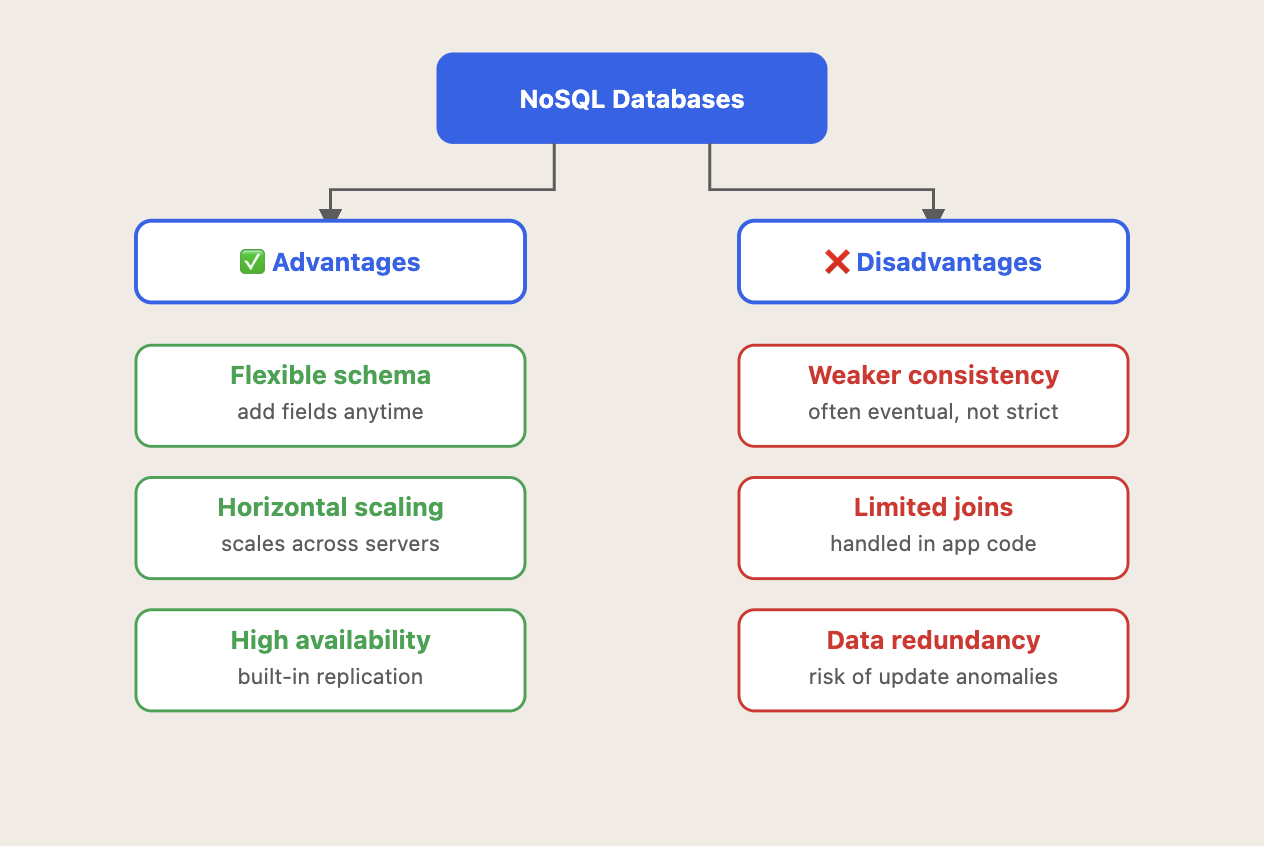
Flexible schema — documents in the same collection don't need identical fields; you can add new attributes to some records without altering every existing row.
Horizontal scalability — designed to scale out across many servers (sharding) rather than scaling up a single machine, which suits very large datasets and high traffic.
High performance for specific access patterns — key-value and document stores can retrieve data in a single lookup instead of multiple joins.
Handles unstructured/semi-structured data well — good fit for JSON, logs, sensor data, social media content, and other data that doesn't map cleanly to fixed tables.
High availability — many NoSQL systems are built around replication and partition tolerance, favoring availability during network issues (per the CAP theorem).
Faster development iteration — since the schema isn't rigid, developers can evolve the data model as the application changes, without heavy migrations.
❌ Disadvantages of NoSQL
Weaker consistency guarantees — many NoSQL systems favor eventual consistency over strict (ACID) consistency, so reads can briefly return stale data.
Limited support for complex queries and joins — relationships across collections/documents often have to be handled in application code instead of the database engine.
Less mature tooling and standardization — unlike SQL, there's no single universal query language; each NoSQL database (MongoDB, Cassandra, Redis, Neo4j, etc.) has its own API and conventions.
Data redundancy — denormalized, duplicated data is common (e.g., embedding related data in documents), which can lead to update anomalies if not managed carefully.
Less rigorous data integrity enforcement — fewer built-in constraints (foreign keys, strict typing) compared to relational databases, pushing more validation responsibility onto the application.
Steeper learning curve for teams used to SQL — different data modeling mindset, and choosing the right NoSQL type (document vs key-value vs column vs graph) for a given problem isn't always obvious.