🔹 What is Aggregation?
Aggregation is a concept in Entity-Relationship (ER) modeling used to represent a relationship between a relationship set and another entity set. It helps model more complex real-world situations where a relationship itself becomes an entity for further relationships.
🔹 Why is Aggregation Needed?
Normally, only entities can participate in relationships. But sometimes we need to relate a relationship with another entity.
Aggregation:
The relationship between two entities is handled as a single entity in aggregate.
When relationships between entities are aggregated, a higher-level entity is created.
The relationship between an entity and a relationship, which may be necessary in some cases, cannot be represented in an ER diagram.
In some circumstances, a relationship between two entities that correspond to it is combined into a higher-level entity.
It is possible to describe connections as higher-level entity sets through the abstraction of aggregation.
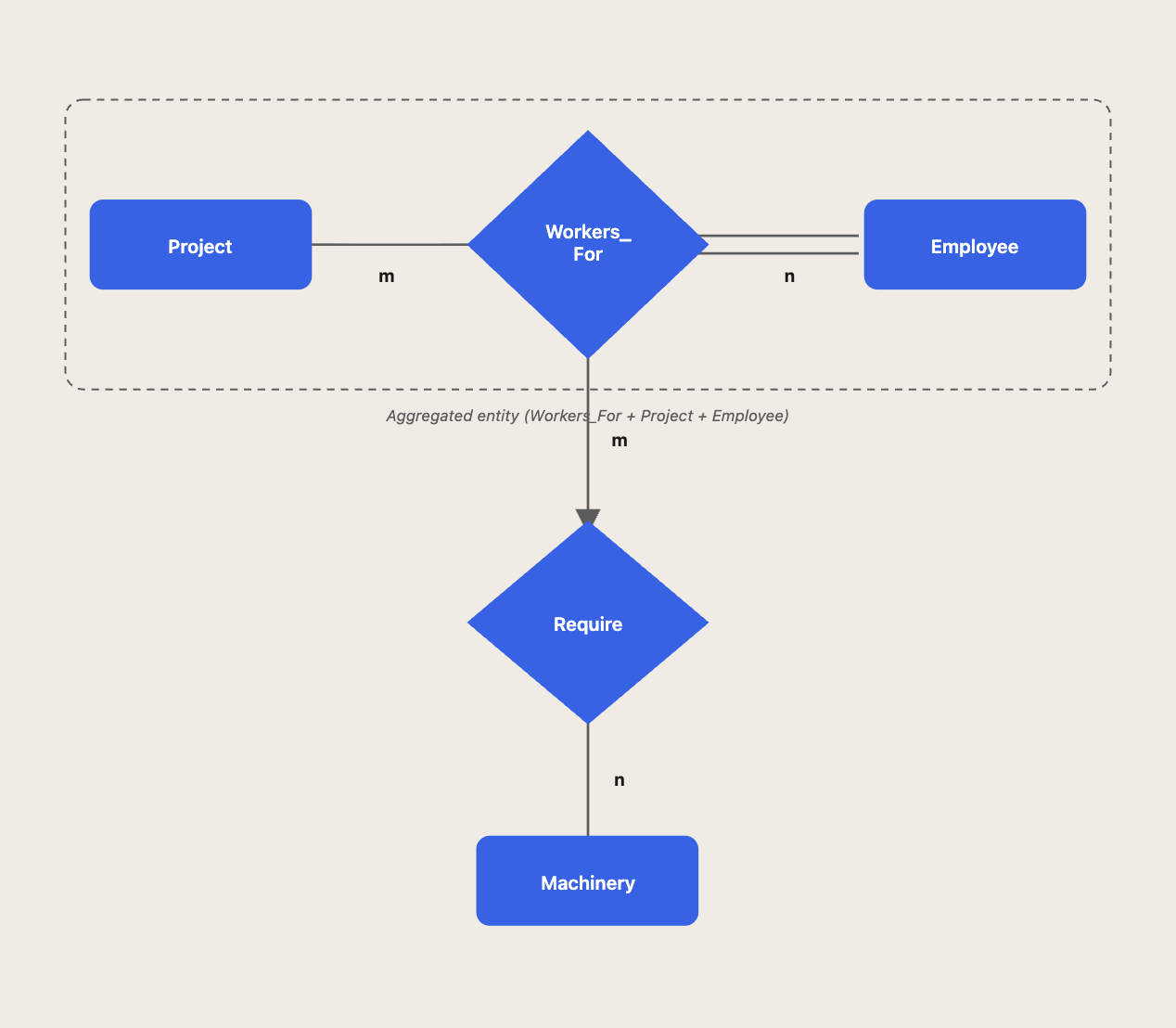
For Example, An employee working on a project, for instance, could need some equipment. In order to connect the connection WORKS_FOR and entity MACHINERY, a REQUIRE relationship is required. The connection WORKS_FOR with its components EMPLOYEE and PROJECT is aggregated into a single entity using aggregation, and a relationship REQUIRE is established between the aggregated entity and MACHINERY.
📌 Difference Between Aggregation and Generalization
Feature | Aggregation | Generalization |
|---|---|---|
Involves | Relationship treated as entity | Subclassing of entities |
Purpose | To link relationship to another entity | To model hierarchy |
Example | Dept supervises “Works_On” | Manager is a kind of Employee |